Tag Archive for: AASL

Serendipitous Digitization Results in Open Access to Two Canadian Architecture Journals

AASL Column, October 2018
Lucy Campbell and Barbara Opar, column editors

Column by Allison Fulford, Architecture Librarian, Dalhousie University Libraries, Dalhousie University Halifax, NS Canada

It is incredible what can be accomplished when circumstances demand novel solutions, creativity, and perseverance. In 2008, a staffing reorganization at Dalhousie University’s Sexton Design & Technology Library, prompted the creation of a Digitization Team. Though most Team members had no related experience, their transferable skills included attention to detail, and expertise in the procedures of providing access to print and electronic library material.

Coincident with the reorganization was a request from the Society for the Study of Architecture in Canada (SSAC), to digitize the Society’s Journal from 1975 to the present, and to provide access through a freely accessible website. The Journal is bilingual and refereed, covering Canadian architecture from all historical periods and from diverse cultural traditions. The reorganization and this well-timed request from the Society propelled the Team forward into the world of digitization.

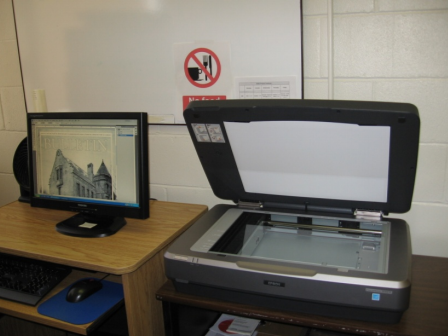
But where to start? A digitization infrastructure was needed. The Dalhousie University Archives donated a large flatbed scanner and computer, including the Creative Suite software; the Dalhousie Libraries provided secure file storage space. Through reading and workshop attendance Team members learned the technical aspects of digitization, scanning procedures and specifications, PDF creation, Optical Character Recognition (OCR), and website construction. Trial and error played big roles too, with steps forward and backward.

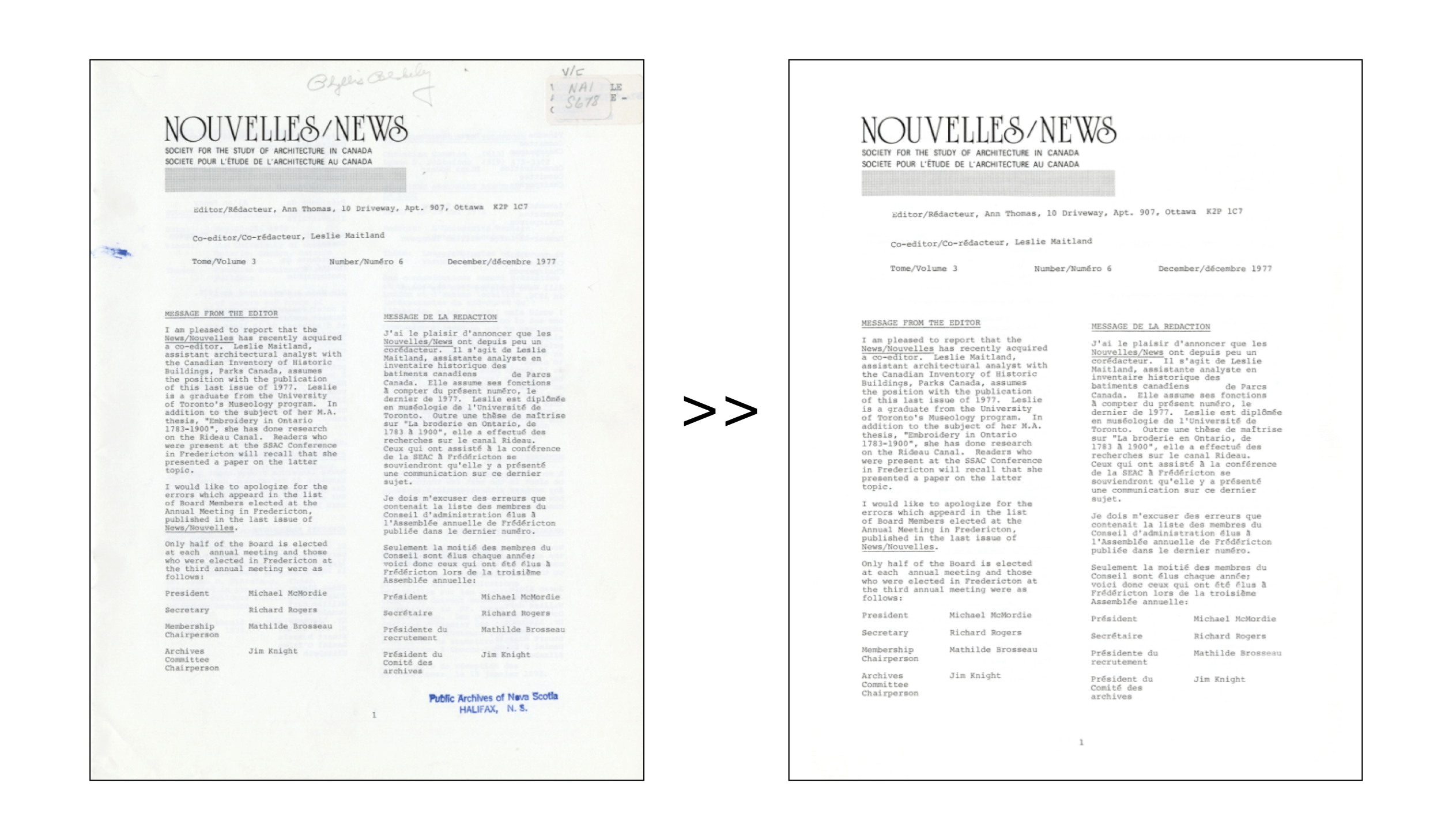
The Team of six started scanning but soon decided that the resulting scans, though legible, were not all that pretty. A decision was made to ‘clean-up’ each scan. The Team straightened and resized pages, adjusted colours, and removed marks and stamps – a tremendous amount of work that ran from mid-2009 to early 2011. The results were definitely worth the effort and elevated the quality of the entire project. Next, the Team created issue-level PDFs, ran them through OCR software to allow keyword searching, and loaded them on the project website (http://sextondigital.library.dal.ca/jssac/).______________ Launched in 2012, the digitized Journal garnered gratifying feedback from the Society, which boosted Team confidence. This confidence would be necessary as a second, even larger project, soon came along.

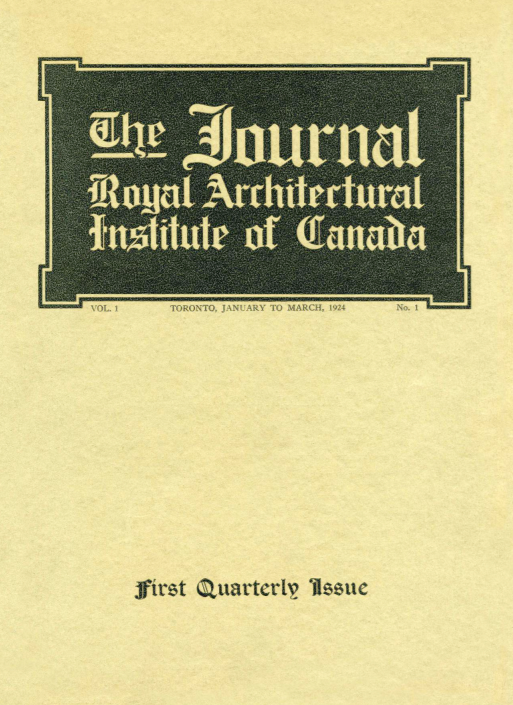
Later in 2012, we agreed to digitize the Royal Architectural Institute of Canada’s (RAIC) Journal from 1924 to 1974. The publication offered an important documentary history of the development of architecture and of architectural practices in Canada. What was fundamental in bringing about the collaboration with the RAIC, was the quality of work that the Team had produced on the SSAC’s digital archive.

The vast RAIC project was not one that the Team could undertake on its own – extra staff and funding were needed. With backing from RAIC, a Canada Council for the Arts grant, and support from the University Librarian at Dalhousie, the project could commence.

The Team hired two keen and dedicated School of Information Management students who improved and updated procedures relating to scanned image clean-up in Photoshop. Even so, the project crept along – the volume of work was enormous – not just the scope of the Journal archive, but the length of some issues. Procedures were streamlined and then streamlined even further in an effort to complete the project in a realistic time frame. The Team leader even took a six-month sabbatical in 2016 to devote as much time as possible to the project. After some staff retirements and new work assignments for remaining Team members, clean-up was eventually dropped all together. Project work was finally completed in the summer of 2018. Most PDF issues are on the open access website (http://sextondigital.library.dal.ca/RAIC/index.html), and final issues continue to be added.

We never thought we’d see the end of the RAIC project. Persistence, patience, and adaptability characterized our ten years of experience in the digitization field. With support from the SSAC, the RAIC, the Canada Council, the Dalhousie Libraries, and from colleagues, we succeeded in providing online, open access to two journals significant to the study of architecture in Canada.

Archaeology and Architecture in the Holy Land: Experience, Pilgrimage, and Documentation in Jerusalem and Israel


Lucy Campbell and Barbara Opar, column editors
Column by  Michelle Amirkhanian, freelance writer

As a child in Bible school I used to dream about swimming in the Dead Sea.  Fortunately, that dream came true for me this summer.  In June of 2018, I travelled on a pilgrimage with my Armenian church to visit a number of biblical sites and document their architectural history and culture.

In Jerusalem routines revolve around three religions sharing space on a daily basis.  Minaret music plays calling Muslims to daily prayers, while Jewish residents are in black robes, women wear headscarves, and kids go to Temple to pray and read the Torah. This is what makes this place holy. The world knows there is a lot of politics in the Holy Land.  I can only say that with every positive purpose about Jerusalem the dynamics of contemporary politics make it a paradox.  For instance, currently, Christians cannot visit Bethlehem, where Jesus was born, due to politics over who has rights to the territory.

Cities in Israel near Tel Aviv like Haifa and Jaffa port on the Mediterranean are metropolitan and modern architecture is prominent.  There exists a sharp contrast between old and new, or biblical and contemporary.

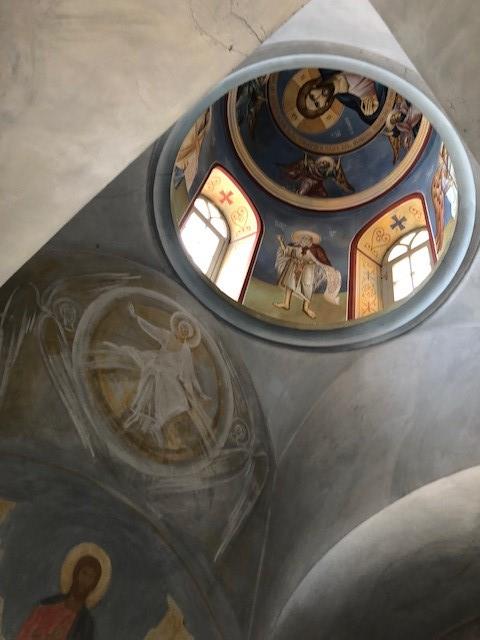
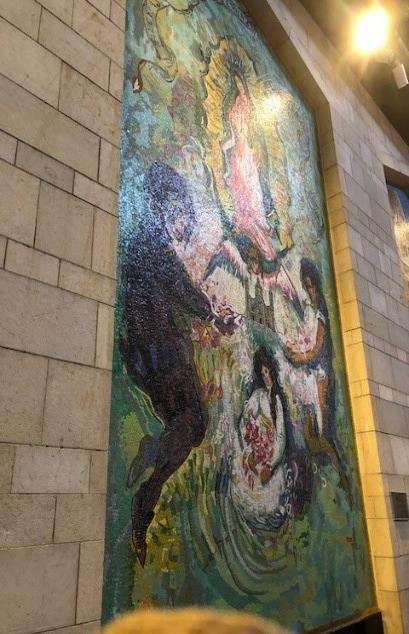
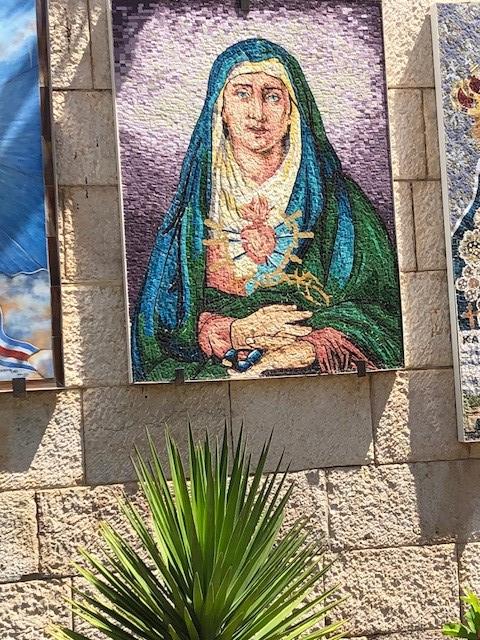
Restoration and/or historic conservation is being completed on many churches and holy sites throughout Jerusalem and Armenia.  Archaeology is also applied to rescue tile floors, paintings and mosaics discovered behind deteriorating walls.  Documentation of the art and architecture is shared here.


The Nativity Church


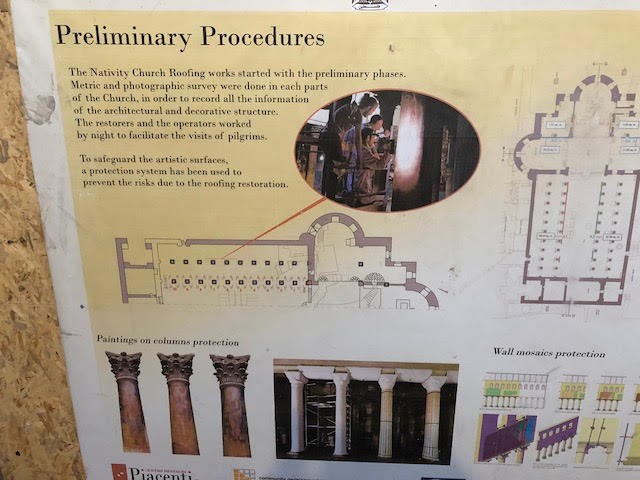
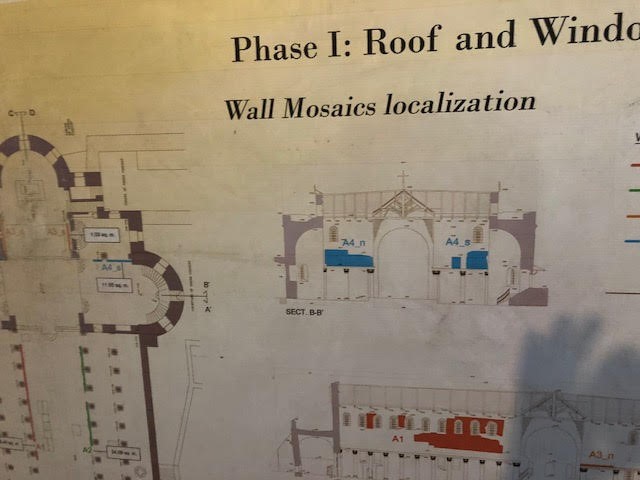
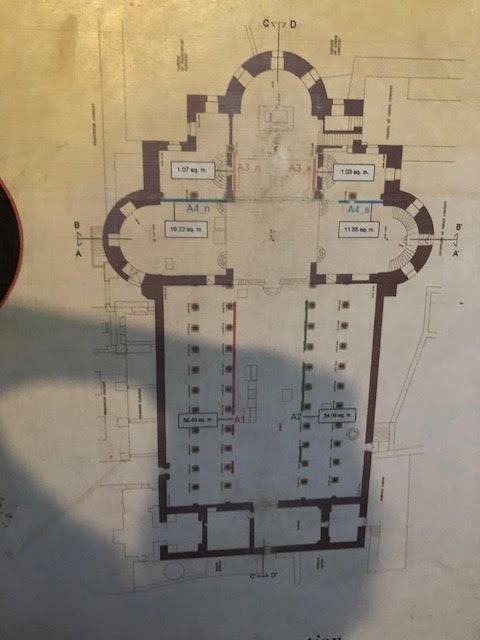
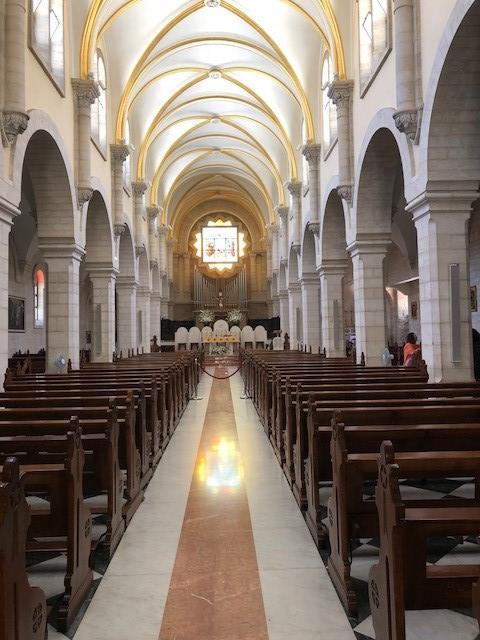
The Restoration of the Nativity Church is taking place in Israel.  The process and plans were posted alongside the archaeological work, where tile was found underneath the excavated ground floor.


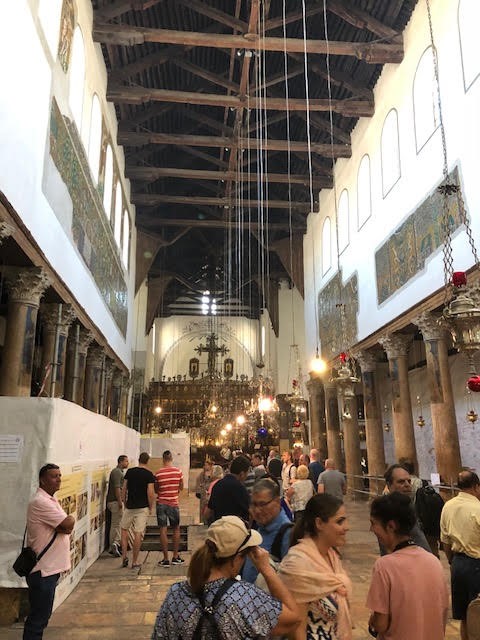
The Nativity Church exemplifies how to protect painting on columns and wall mosaics, and how to approach preservation needs.


Although there is an ongoing restoration project at The Nativity Church, the doors are open to the public.  However scaffolds and walls are torn down, and visitors must envision the final outcome of the restoration project while avoiding closed off areas and floors in poor condition.

Another example of sites being restored. New findings are being discovered under the buildings of these holy sites.


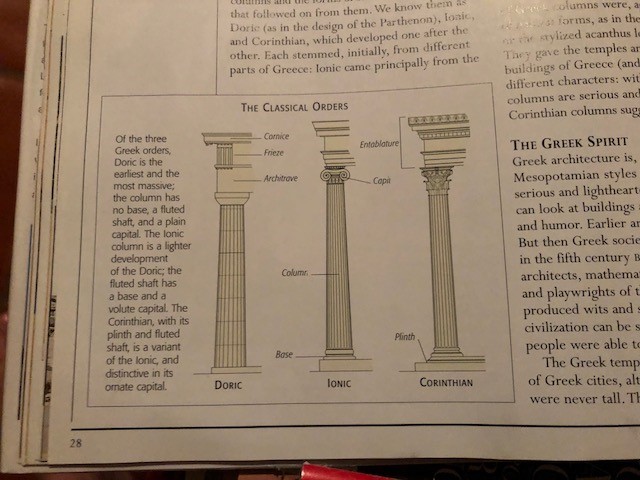
The Classical Orders


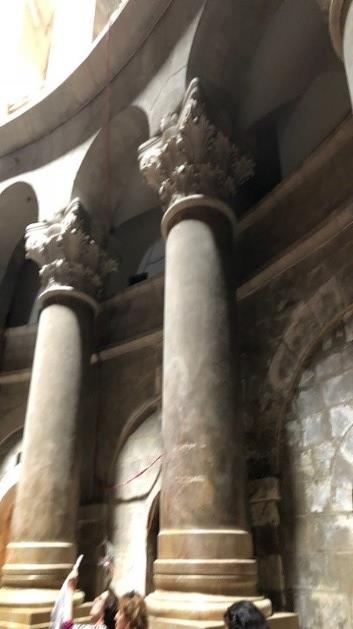
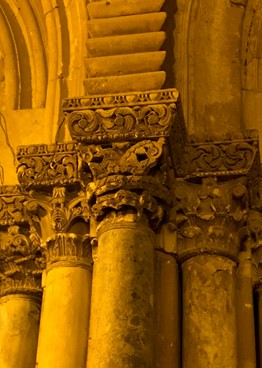
Buildings feature the three Greek Orders of Doric, Ionic, and Corinthian columns. Some have paintings that require restoration and cleaning.  These pictures are some of the columns I documented during my trip.

Photos of Corinthian column found in Jerusalem’s many holy edifices are provided below.


Dome of the Rock    

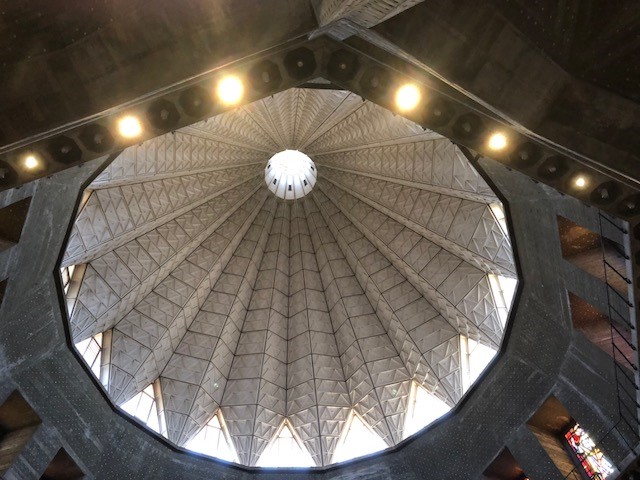
Dome of the Rock in Jerusalem was restored by Byzantine architect Antonio Barluzzi (1884-1960). Over 25 structures Barluzzi completed have since been restored and rebuilt in the Holy Land.  The Custodia Terrea Sanctae Franciscan missionaries’ site lists his completed projects.  These sites would not be in existence had it not been for Barluzzi’s talents in Byzantine Architecture and restoration.


Dome of the Rock in Jerusalem restoration


Church of St. Mary Magdalene

The Church of the Holy Sepulchre


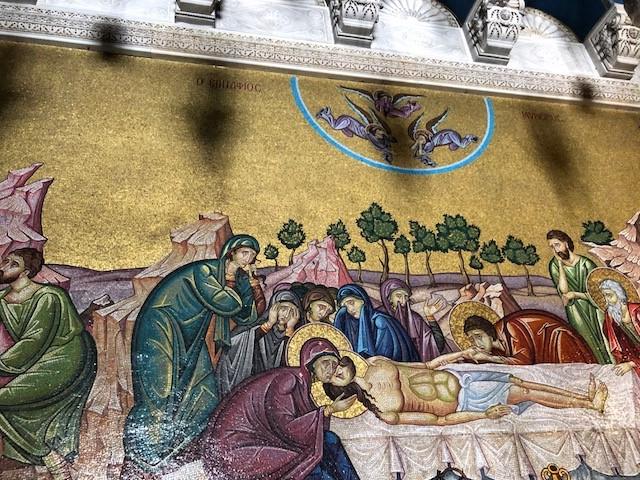
The Holy Sepulchre was quite moving.  There is a keyholder that is there to open the gate in the morning and close the gate.  The key is like a key during Biblical times and so are the doors.  The courtyard of the Holy Sepulchre displays the platform where Jesus stood and was sentenced to crucifixion by Pontius Pilate and inside is the “Golgotha” or where the empty tomb of Jesus is established.  The Greek Orthodox, Catholics and Armenian orthodox have points and designated quarter within the Holy Sepulchre.  Also, the Coptic, Ethiopian Orthodox, and Syriacs have much smaller quarters in the Church.  Also, there is a Jewish site within the Holy Sepulchre.  Finally, the awesome Edicule was restored last year and is in a sense the central piece of the Holy Sepulchre.

The Edicule within the Holy Sepulchre


Fine Mastery of Byzantine Architecture

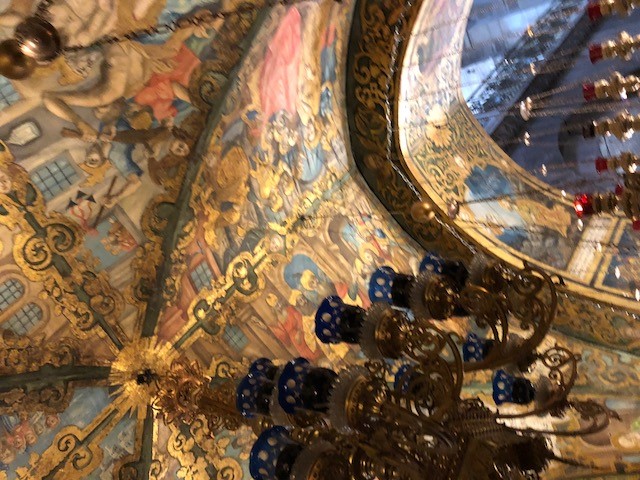
In the Holy Land pilgrims often notice opulence such as intricate mosaics, gold-plated paintings, Tiffany glass, and the creative awesome ceilings that are unapologetic of their existence. In visiting the Holy Land, I felt a strong connection to my religious beliefs which made the entire experience even more fulfilling.


A New Playing Field: Collaboration in Digital Scholarship

Lucy Campbell and Barbara Opar, column editors
Column by Maya Gervits, PhD, Director, Barbara & Leonard Littman Library, NJIT

In the rapidly changing information environment, the nature of the academic library and the role of librarians are both undergoing a fundamental shift away from merely curating scholarly materials toward the co-creation of these materials in active engagement and collaboration with researchers and other members of the academic community.This shift provides new opportunities for libraries to have increased visibility amongst scholars.

At the Littman Library at NJIT collaboration with the College of Architecture and Design (CoAD) faculty and students manifests itself in numerous ways. We strive to provide responsive services and to accommodate various learning opportunities. We act as guest lecturers for a variety of classes, conduct workshops, and compile citation analysis for the Promotion and Tenure Committee.  Our “Music in the Library” program is incorporated into the college curriculum. The Library curates various exhibitions that present materials from its collection to support and encourage student and faculty creative work. The regular evening concert series provides a complementary mode to consider visual art and design works in historical cultural contexts. We provide guidance on copyright and host regular lunchtime Author Book Talks.

But we are always looking for additional ways to engage with our patrons. An important new role is Digital Scholarship. Contemporary research in many areas has expanded beyond what is considered traditional. Over the last decade, many academic libraries have established Digital Scholarship Labs or Centers. Equipped with advanced technological tools, these new facilities enable students and faculty to explore new methodologies, analyze complex data, and share the results of research in ways never before possible.

Nevertheless, despite all the advancements, digital scholarship in art and design disciplines has yet to define the parameters of this field. How can digital methods and tools benefit research? How can a small branch library facilitate collaboration?  At NJIT all colleges are engaged in digital initiatives and related activities. The College of Architecture and Design is well known as a pioneer and innovator in the application of digital and information technology to augment and benefit the design process. These  students have access to different labs where they can work on digital prototyping, fabrication, animation, robotics, augmented, and virtual reality.

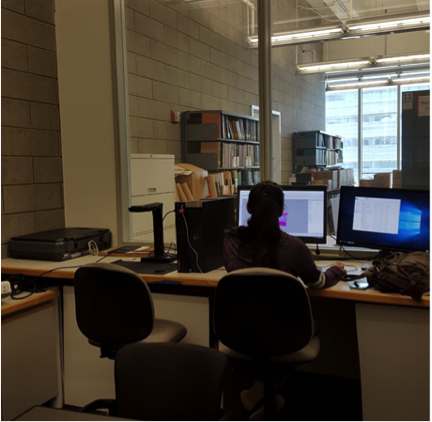
Over the years, the Littman Library – the only branch library on campus, located in the heart of the College of Architecture and Design main facility- has been involved in   activities which have ranged from the digitization of its collections to more complex undertakings.  Because of the growing interest by faculty and students and the increased number of projects they were producing, the Littman Library decided to dedicate a special space to digital scholarship. We repurposed the slide room and equipped it with two computers, flat-bed, slide, and book scanners, printer, and an Oculus Rift virtual reality set. We secured server space and downloaded software for data visualization, online publishing, textual and spatial analysis.  We recently had the good fortune to receive a significant external endowment to further develop the Lab. But the initial phase has been completed with modest funding and limited staff time.

Recognizing the need to educate not only students but also ourselves we introduced the ”Skills Exchange” program which is a series of workshops focused on mastering various software. We compiled research guides “Software at the College of Architecture and Design” and “Resources in Digital Scholarship” and added a subscription to the commercially distributed library of online tutorials Pluralsight to allow for self-paced learning with high quality educational support materials.

Virtual Reality technology revolutionizes both how architecture is being designed and how it can be perceived. Using the Lab, students and faculty simulate realistic experiences of the built environment, explore their designs in Virtual Reality, reconstruct historical monuments, and work on projects that employ digital tools and methods.

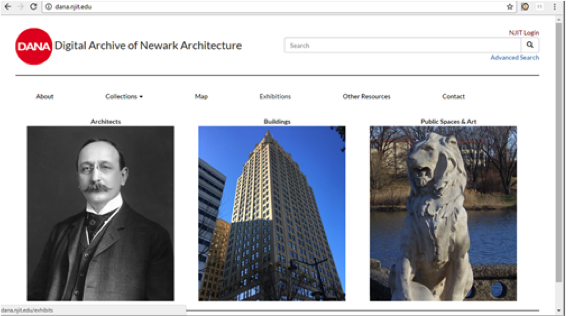
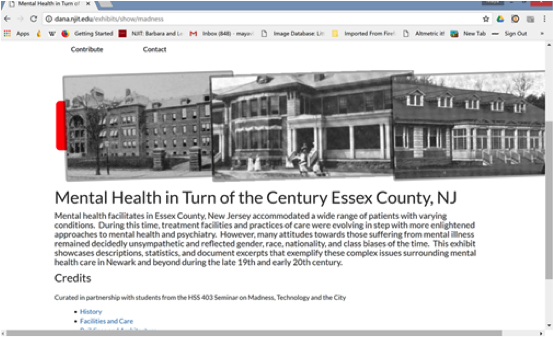
Our Image Database supports technical building systems, history, and studio classes. Digitized maps formed the core of the Digital Archive of Newark Architecture (http://dana.njit.edu)- a project conceived to document the built environment of Newark that has grown into a gateway of information related to the physical life of Newark, its architecture, infrastructure, public art, and city planning.

______ Recent implementation of ArcGIS allows for data to be analyzed and visualized in a different way. An additional crowdsourcing function enables the public to submit materials over the web, and a mobile application with location awareness provides for a more engaging user experience. Other projects designed in collaboration with CoAD faculty and students are focused on the application of Virtual Reality to digital architectural history, and employ various publishing platforms, tools for visualization, and space analysis. The photogrammetry technique is being implemented to create a searchable version of the virtual collection of electrical measuring Instruments (housed in Van Houten Library). And the recent “History of the College of Architecture and Design” initiative aims to preserve the College’s past by digitizing old photographs, video and audio recordings, documents, and born digital materials.

To increase collaboration at NJIT, both faculty and staff from various university divisions have formed a special interest group concerned with digital scholarship. NJIT also joined the New Jersey Digital Humanities Consortium – a group of enthusiasts and professionals from various New Jersey institutions. This helps us coordinate our activities and share pertinent information. The members of this group strongly believe that we can utilize our intellectual and creative potentials more effectively by working collaboratively across disciplines; that the library not only supports various digital initiatives pursued and promoted by the CoAD faculty and administration, but can also act as an active partner.

Thinking Tools for Architecture and Design Libraries

Lucy Campbell and Barbara Opar, column editors
Column by Rebecca Barham, Art, Dance & Theatre Reference Librarian, University of North Texas Libraries and Dr. Susan Smith, Director of Library Services, Trinity River Campus, Tarrant County College Design
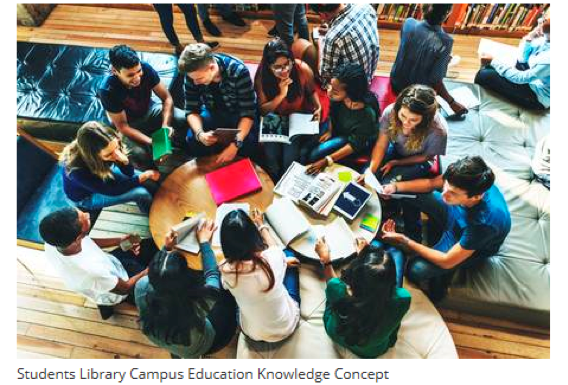
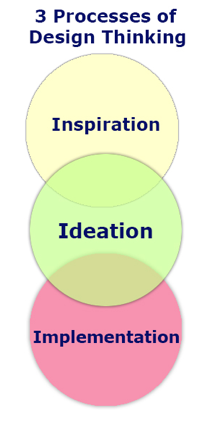
Do you use design thinking methodologies in class? If so, then you are aware of the potential for innovative problem solving that design thinking offers. For those who have not heard of design thinking, a short introduction is in order. Design thinking is a series of overlapping processes involving inspiration, ideation and implementation that has been used to create successful businesses and desirable products. During the inspiration process, the design challenge or problem is identified. In the ideation phase, design thinking tools are used to generate ideas to solve the problem. Then during the implementation process, the generated ideas are made into a series of rapid prototypes and feedback gathered on each prototype.
These same processes of design thinking can be utilized in the strategy and management of academic libraries to provide solutions to some of the challenges we face. Some common challenges include:  how to engage with patrons in new ways, how to get students involved in the design of the library space, patron-centered collection development, and doing more with limited budgets. In this column, we will highlight design thinking tools that can be applied to help solve these challenges.
Engaging patrons in new ways.              
Empower patrons to be co-creators of the library by forming library advisory boards. Consider forming boards focused around specific patron or stakeholder groups, such as graduate or undergraduate students, or faculty. Advisory board members provide valuable input on library services, products, spaces, and marketing to their peers. They also serve to represent the library to peers.
 
Getting students involved in the design of the library space.            
Ask students to share images and descriptions of their ideal study or library spaces via an image/text survey. Survey respondents can upload images to any survey tool that has an option for questions that include file uploads and text entry.  Another way that patrons can be involved in the design of library space is to create models, renderings or videos of spaces and furniture that they can participate in or vote on. Cardboard models of furniture, counters, and wall dividers can be created and moved around to better visualize the space. Design contests with valuable prizes are also useful incentives.
Design thinking tools for collection development.            
Patron Driven Acquisitions (PDA) are a great way to get patrons involved in collection development. In PDA, records of books that are not owned by the library are loaded in the catalog and patrons unknowingly initialize the purchase of a book when a set use criteria is met. Patrons can also participate in collection development by requesting or voting for a book, journal or database via a recommendation box, library website link, or a list of newly published books. Librarians can obtain lists of new books in specific call number ranges from email alerts set in web-based book acquisition systems.
Design thinking tools and limited budgets.             
Since design thinking is centered on the needs of the patron, it can help to insure that money is used to buy resources that are needed and will be used. In addition, iterative rapid prototypes and feedback on the prototypes during the implementation process helps to reveal usefulness and costly problems before money is spent.

#rarebookfriday: Systematizing an Approach to Social Media to Reach a Targeted Audience

Lucy Campbell and Barbara Opar, column editors

Column by Viveca Pattison Robichaud, Special Collections Librarian, Architecture Library, University of Notre Dame

Architecture libraries and their librarians provide a wealth of services and expertise, but have you ever wondered what some of their strategies are to disseminate this information? Since no one library or librarian is the same, outreach approaches are similarly diverse. One strategy, employed in the Architecture Library at the University of Notre Dame, is to promote collections and services through the use of social media. Many architecture libraries have a Facebook page, Instagram and/or Twitter accounts, with many more blogging, creating online exhibits, and interacting online with patrons in a myriad of ways. Starting in the 2011-2012 academic year, under my direction, the Architecture Library sought to develop a coherent social media strategy. The first step in this process was to determine who exactly our audience would be. Once I understood who I wanted to reach, I could start developing a systematic approach to effectively promote the library and its collections.
 

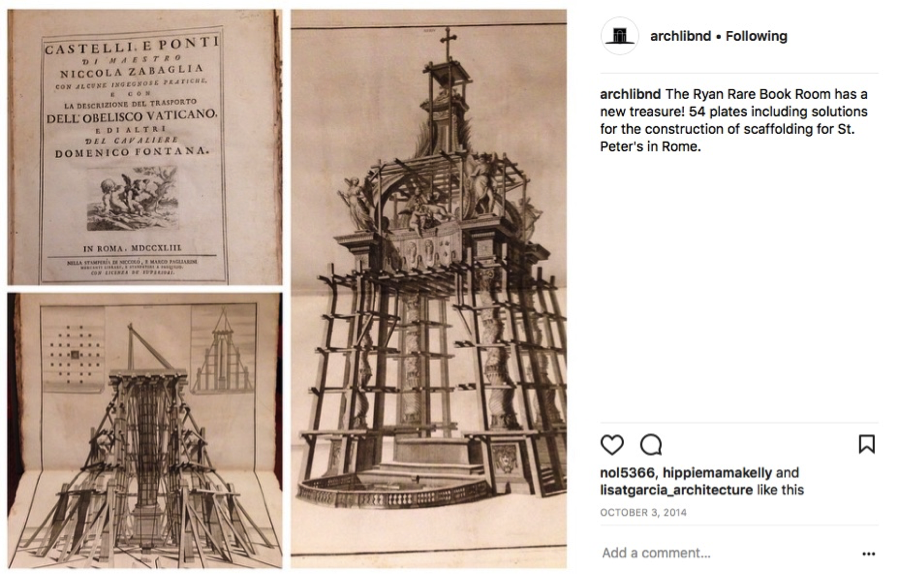
New Book Acquisition, October 3, 2014.
 
At some point, before I joined the Architecture Library, a Facebook account was created, however, it was no longer being used and did not have many connections. My first step was to create a fresh new Architecture Library page and start posting. While our page started to slowly gain followers, the numbers were not where I wanted them to be. What was helpful, though, was seeing that most of our followers were not our regular faculty and student patrons, but instead consisted of alums and people interested in the School of Architecture who were not on campus regularly. It was important for me to realize that our students and faculty were already engaging with our collection physically, so they did not need to spend time engaging with us virtually.
 

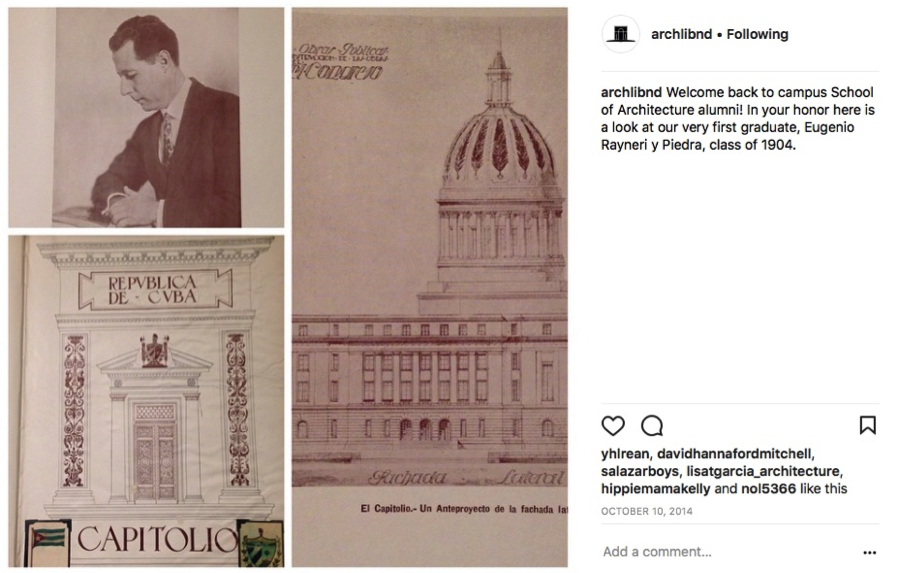
Post tied in with Alumni weekend, celebrating the School of Architecture’s first graduate, October 10, 2014.
 
In the summer of 2014, after a few years of Facebook activity, the Architecture Library joined Instagram and Twitter. Based on the literature related to successful social media strategies and according to the School of Architecture’s Director of Communications, it was clear to me that regularly posting helps grow a following. That being said, posting too frequently could also have a negative impact and overwhelm users, causing them to ignore or unfollow accounts. Since our library collection and staff is relatively small, with all of the social media posting falling into my workload, I decided to set myself a moderate task of posting once a week. Since I spend Fridays at our circulation desk, I have worked a social media post into my Friday routine.
 

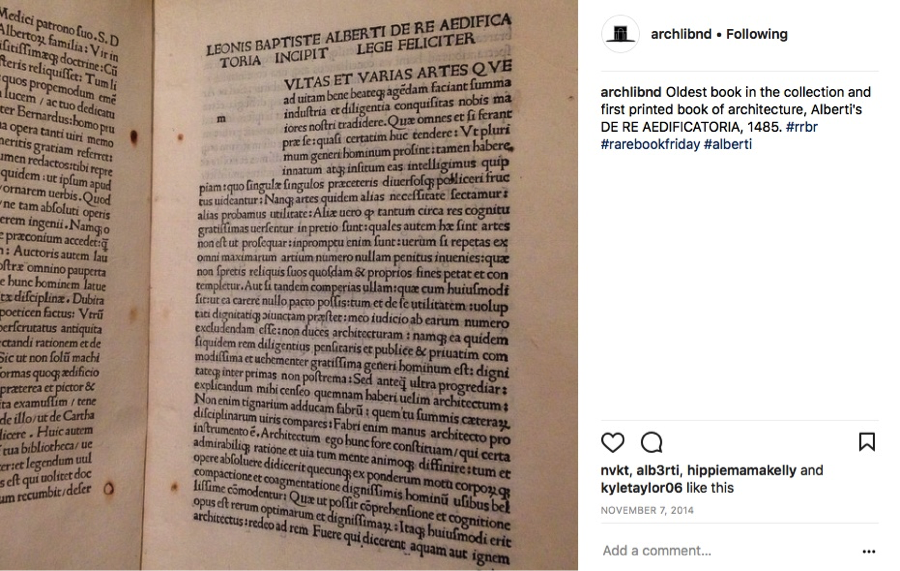
Oldest book in the collection post, November 7, 2014.
 
Architecture is a very visual discipline, so Instagram is my primary mode of social media interaction, which I then disseminate to Facebook and Twitter, in order to engage with the most followers. After posting a few different kinds of posts, I decided focus on highlighting and promoting what is truly unique about our library: our rare book collection. Our Ryan Rare Book Room, which contains a significant number of rare and unique texts from 1485 through the 20th century, is open to students, faculty, and the general public. That being said, any patron, regardless of affiliation, would need to make an appointment and request specific titles, so the collection is not browseable like the rest of the library’s holdings. Highlighting these books, therefore, appeals to both our campus patrons and our off-campus admirers. Those on site who are interested in engaging with us on social media are not getting redundant information, but rather, are being introduced to titles housed in the library that they would not find on their own. Alums, colleagues, and other followers are also treated to snippets of our collection, which, should they find themselves on campus, would be outside of their normal access.
 

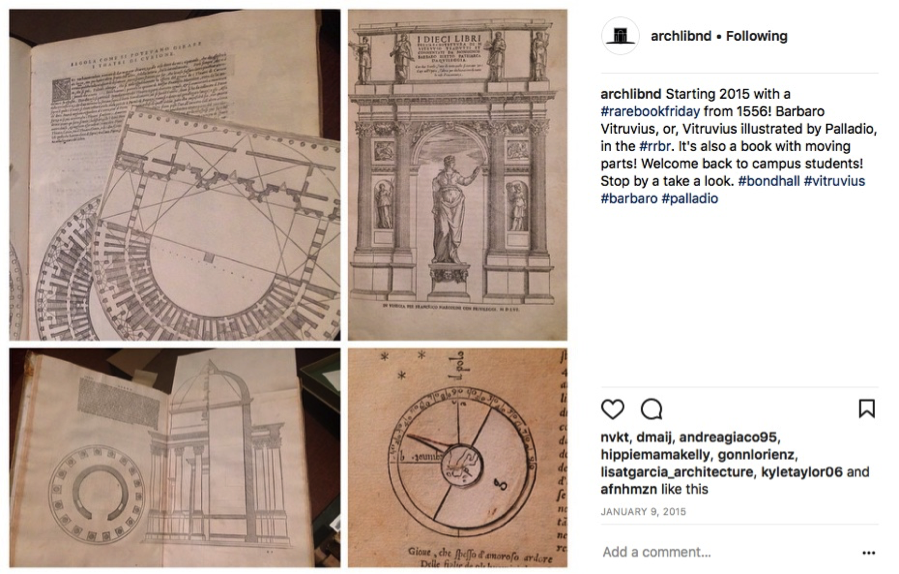
Barbaro Vitruvius, January 9, 2015.
 
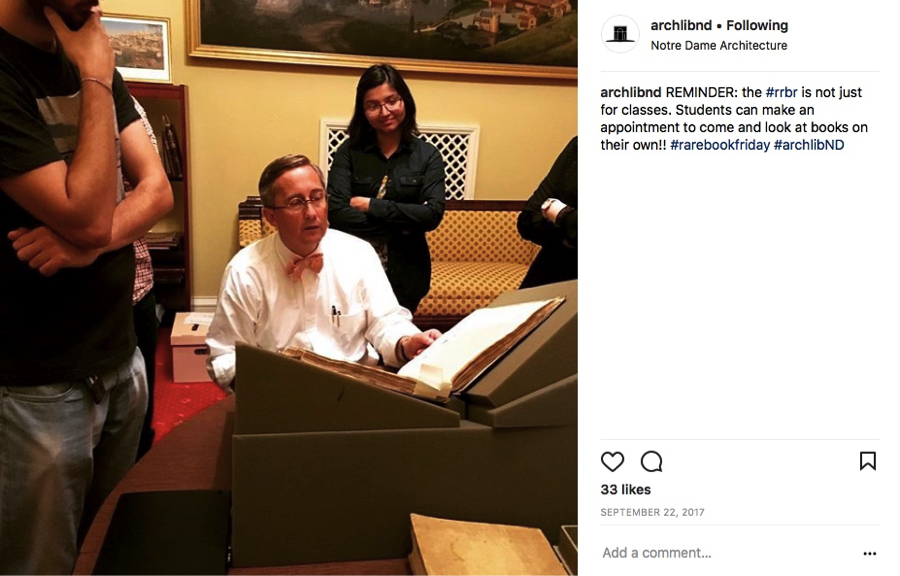
Under the #rarebookfriday I post weekly pictures of titles from our collection. The first few posts wrote themselves, showcasing our most beloved books. In subsequent weeks and over the years, I have tried to tie in posts about what is happening on campus, like reunions, perspective students visiting campus, classes using the collection, other moments in the academic year, and, of course, football rivalries. This platform is also a great way to publicize new titles added to the collection. Increasingly, social media is also a venue for our library to interact publicly with the School of Architecture’s profiles, as we both can share, like, tag, and retweet each other’s posts. I try to have fun with these posts and it certainly seems to be gaining traction, especially on Instagram, with each post accumulating more likes than the last.
 
Follow us: @ArchLibND (Facebook, Instagram, and Twitter)
 

Students with faculty member Duncan Stroik, September 22, 2017.
 

Irish apple from AI Downing, to tie in with fall break, October 14, 2016.
 

Prospective students seeing a selection of books from the Ryan Rate Book Room, April 22, 2016.
 

Bucrania from Vignola to tie in with a football game against Texas, September 4, 2015.


Library Summer Project: Collections Review

Lucy Campbell and Barbara Opar, column editors

Column by Amy Trendler, Architecture Librarian, Ball State University Libraries, aetrendler@bsu.edu

It’s the end of another academic year and the library shelves are likely looking pretty crowded. Libraries that support disciplines like architecture, where physical books and design magazines continue to be essential, often face a shortage of shelf space. As a result, summer is a popular time for librarians to engage in collection review, identify books to remove or transfer, and alleviate the overcrowding on the shelves. Typically, titles with low circulation rates and older publication dates are closely scrutinized to determine if the book is outdated or no longer relevant to the library collection. Second copies and earlier editions are also prime candidates for review, which may lead to the removal of one item and the retention of a duplicate or similar item. However, there is such a dire space crunch in some libraries that reviewing and removing a portion of the books in any or all of these categories does not significantly impact the size of the collection. When that’s the case, librarians have to identify additional criteria for review.


This was the situation in our library after we completed collection reviews for second copies, earlier editions, little-used or outdated titles and then discovered that we were still left with overcrowded shelves. After asking librarian colleagues for advice, reading articles like Janine Henri’s August 2017 article in this column (“Struggling with Space: Collection Browsing, Architectural Illustrations, and Remote Storage Decisions,” on the UCLA Arts Library’s review process) with great interest, and considering our options, I began reviewing the library’s collection based on additional criteria that fit our particular situation. My takeaway from the process is that planning for such a collection review should start with considering all the variables that define the library or the project at hand. These include the library mission, the curriculum, the time available for the collection review, timing of any planned changes to the space, staff availability, consortia agreements, offsite storage, the possibility of transferring titles to other libraries on campus, access to reports and collections data, and any upcoming changes to administration, faculty, or curriculum that could affect the focus of the collections. By looking closely at these variables, it is possible to plan a collections review that goes beyond basic collections data about checkouts and date of publication.
 

Considering the variables begins to help define their impact on the collection and the implications for the collection review. To take just one example, the library mission statement—whether it is formal or informal—usually describes the library’s user groups and the subjects covered by the collection. The impact might be that any subjects not explicitly included in the mission should be closely reviewed and removed from the collection to be transferred to offsite storage, a main library or other branch library in the system, or withdrawn from the collection altogether. In the case of an architecture library that collects materials in architecture and landscape architecture, books about any topic outside of those two areas, such as art, history, or geography, are candidates for thorough review and possible removal from the architecture library’s collection. Collections data—number of checkouts, date of last checkout, and date of publication—are still factored in, but the range for each of these categories should be set so that they are more expansive than they would be for books in the primary subject areas. For instance, if 0-3 checkouts is the range used to identify books to review for architecture and landscape architecture, then 0-10 or higher should be the range for books on secondary subjects. The same is true when considering consortial agreements. If another library in the consortia is designated as the repository for art or history or geography, then titles in these areas should be more closely reviewed even if offsite storage or transfer are not options.*


In addition to identifying criteria for items to scrutinize and potentially remove, planning for the collection review can also cover which items to keep on the library’s shelves. Depending on the variables, it may be important to prioritize the on-site retention of professional publications, well-illustrated titles (as described in Henri’s article), books intended primarily for an undergraduate or graduate audience, English-language publications, or books closely related to the curriculum or faculty interests. As in many architecture libraries, collections review will continue to be ongoing for us, but by continuing to be thoughtful about the variables I am confident that our reviews will achieve the intended result—a focused, useful, and up-to-date collection that comfortably fits in the space available for it.


*There is software available to help with collection review and comparison between collections. In addition to library systems’ report capabilities, a product such as OCLC’s GreenGlass is designed to assess library collections individually or in consortia.

Renovation of the King + King Architecture Library at Syracuse University

Lucy Campbell and Barbara Opar, column editors
Column by Kara Conley, Syracuse University


On March 29th of this year, the King + King Architecture Library at Syracuse University celebrated its grand reopening after a substantial makeover. The renovation represents a shift toward a library design that (1) accommodates the ever-changing information needs of students and faculty members and (2) allows the library to further strengthen its relationship with the School of Architecture through instruction, outreach, and research.


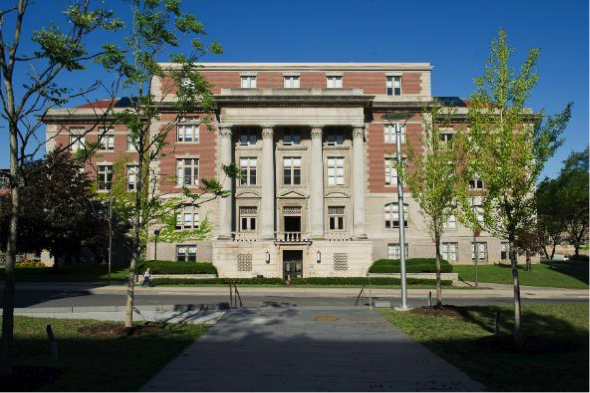
Slocum Hall, home to the King + King Architecture Library.

The King + King Architecture Library is located in Slocum Hall, a five-story Beaux Arts building that is home to Syracuse’s School of Architecture (SOA). Since 2008, the library has been located in a high-traffic area on the third floor of Slocum next to the building’s design studios. It consists of three adjoining rooms that were originally used as classrooms and  faculty offices. Although space is limited, it is a welcoming and light-filled environment. Visitors enter the library in the middle of the three adjoining rooms. Historically, this room has been utilized for circulation, course reserves, current periodicals, and computers for student and faculty use. This has remained the same post-renovation. While the design team did not change the function of the room, they implemented a number of changes to the room’s layout that have enhanced the accessibility and usability of the space.


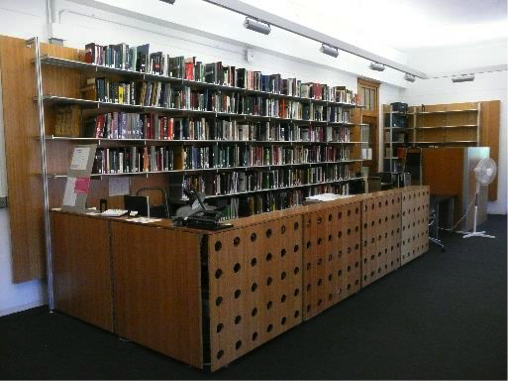
The circulation desk before the renovation. The Architectural Librarian’s cubicle in the back corner of the room.

The first of these changes revolved around the circulation desk. Prior to the renovation, the circulation desk was one long wooden counter that took up a large swath of the room. At the end of the circulation desk stood a cubicle which served as the work station for Barbara Opar, the University’s Architecture Librarian.  The room’s redesign (largely based on the results of a charrette) condensed the size of the circulation desk and moved it to the opposite side of the room. It is now the very first thing visitors see when they walk through the doors of the library. Students and faculty members can approach the desk to talk to a student support staff member or use a computer with the library’s catalog to search for items. As for Barbara’s desk, it has also been moved to the same side of the room as the circulation desk. She is no longer required to sit in an isolated corner. Instead, her desk is an open cubicle that has a side table with extra chairs for research consultations, reference transactions, and small meetings. These changes, albeit small, are impactful. There is now a logical flow of movement from the entrance of the library to the circulation desk, which improves the information search and retrieval process as a whole.

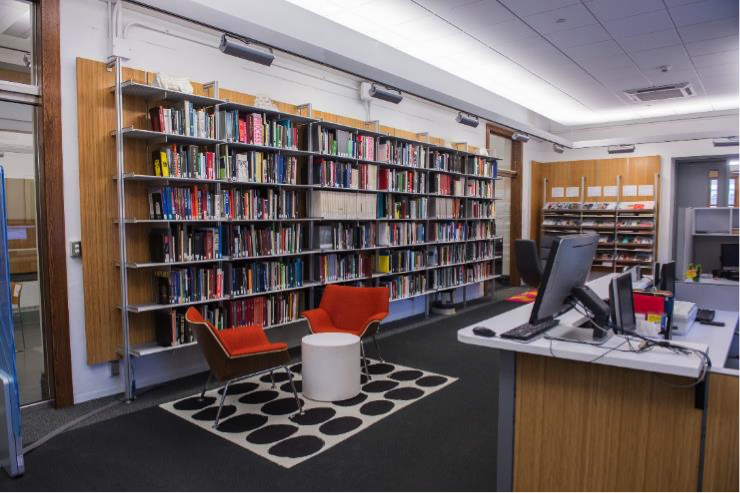
 The course reserves and core materials collection post-renovation.

A second impactful design choice in this room was the decision to keep the library’s essential architecture texts in their original location, rather than moving them behind the new circulation desk. Now, students, faculty, and staff members are welcome to leisurely browse and access the materials. These items circulate for two-hour loans. This decision to “open” the materials reflects the findings of a recent study of architecture faculty in the United States (Campbell, 2017). The study found that architecture faculty members are “frequently looking for inspiration or current trends” when seeking information (Campbell, 2017). By placing the essential texts and current periodicals in an open and accessible location, the library invites faculty members to fulfill their need for relevant and significant materials.

 
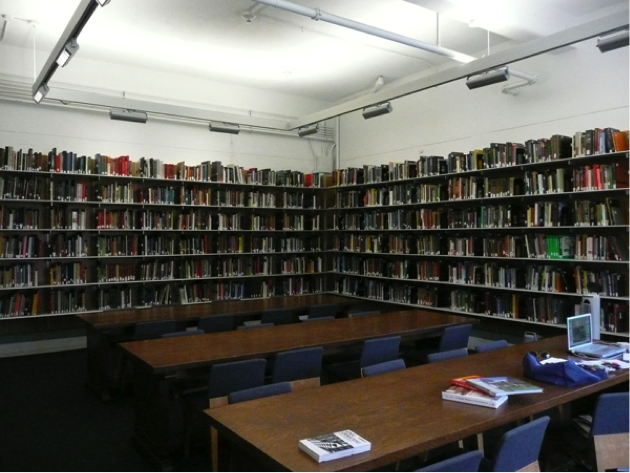
One of the reading rooms prior to renovation.


Before the renovation, the second and third rooms in the King + King Architecture Library contained mostly physical items. One room housed the working drawings collection and the library’s circulating physical materials collection. The other room contained massive wooden tables for studying. Its exterior walls were lined with shelves chock full of books. The space was overcrowded, to say the least.

To open up the space, Barbara worked directly with architecture faculty members to condense the collection and move a number of “non-essential” books to Bird Library, Syracuse University’s art, humanities, and social sciences library. Secondly, the design team decided to move the bulk of the library’s physical materials collection to the Digital Fabrication Lab in the basement of Slocum Hall. The renovation also helped jumpstart a project that had been in the planning stages for years: the digitization of the library’s working drawings collection. The majority of the drawings were shipped to the main library where they are awaiting digitization. That being said, the library did retain a number of drawings that are frequently used by architecture faculty members in their courses.


The new seminar room after renovations.

Today, the space is filled with flexible furniture that can be repositioned depending on its use. Shelves of course reserves and select bound periodical runs line the walls of the rooms, but there is significantly more space than before. On one wall, the shelves have been replaced with two large smart TVs that enhance the technological capability of the library. These changes have allowed the library to better serve the diverse information needs of its users. Students, for example, now have more space to study independently or collaboratively. Faculty members can now conduct lessons in the library with differentiated learning activities. Barbara Opar can now expand her instruction and outreach responsibilities with interactive thesis seminars and instructional sessions. These examples represent a few of the many expanded educational opportunities for the SOA community. Over time, I believe that the design changes will help the King + King Architecture library create strategic and long-lasting partnerships with SOA faculty and students, especially in the areas of instruction, research, and outreach.

Ultimately, the renovation has created a dynamic and flexible space that will be utilized by the School of Architecture at Syracuse University for years to come. If you’re ever in Syracuse, please feel free to stop by King + King Architecture Library on the third floor of Slocum Hall to see the transformation with your own eyes.


The renovations were made possible thanks to a generous donation from the King family in honor of the 150th anniversary of King + King Architecture. King + King Architecture is a Syracuse-based firm that is the oldest architectural firm in continuous practice in New York State.


Sources: Campbell, L. (2017). The information-seeking habits of architecture faculty. College & Research Libraries, 78(6), 761. Retrieved from https://crl.acrl.org/index.php/crl/article/view/16734/18244

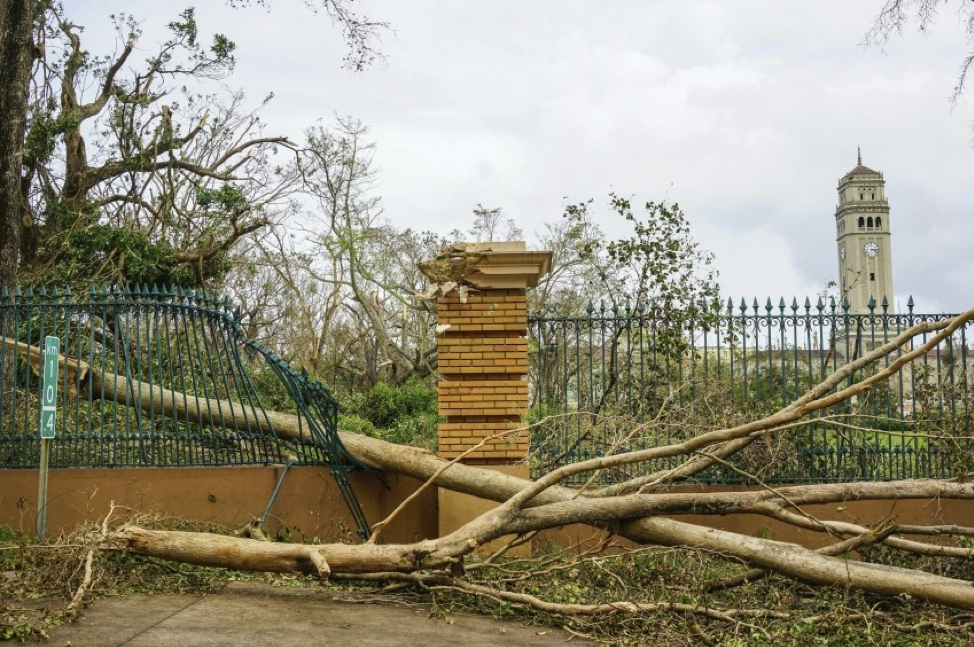
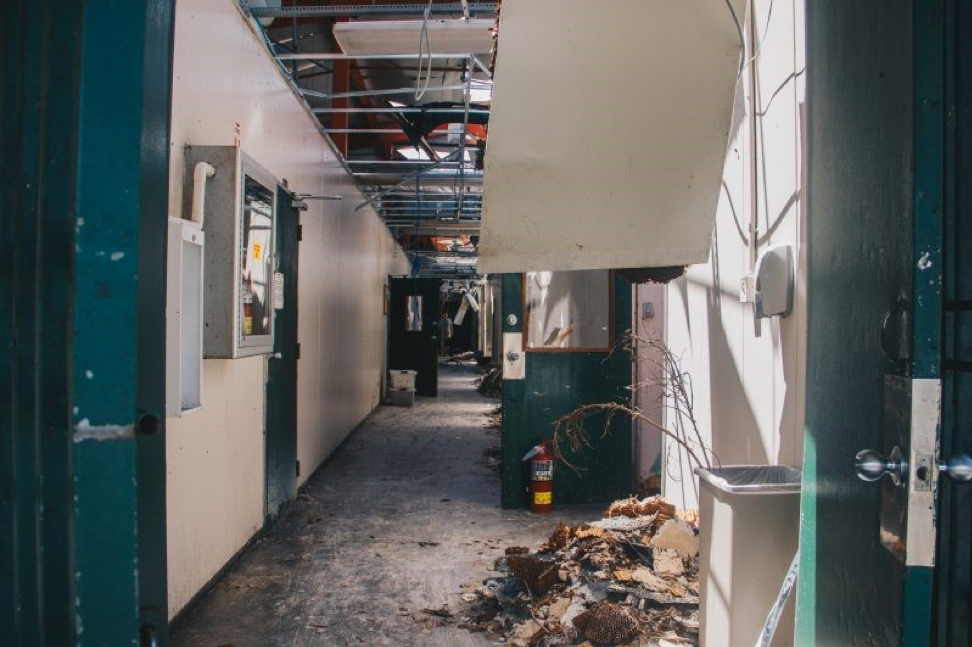
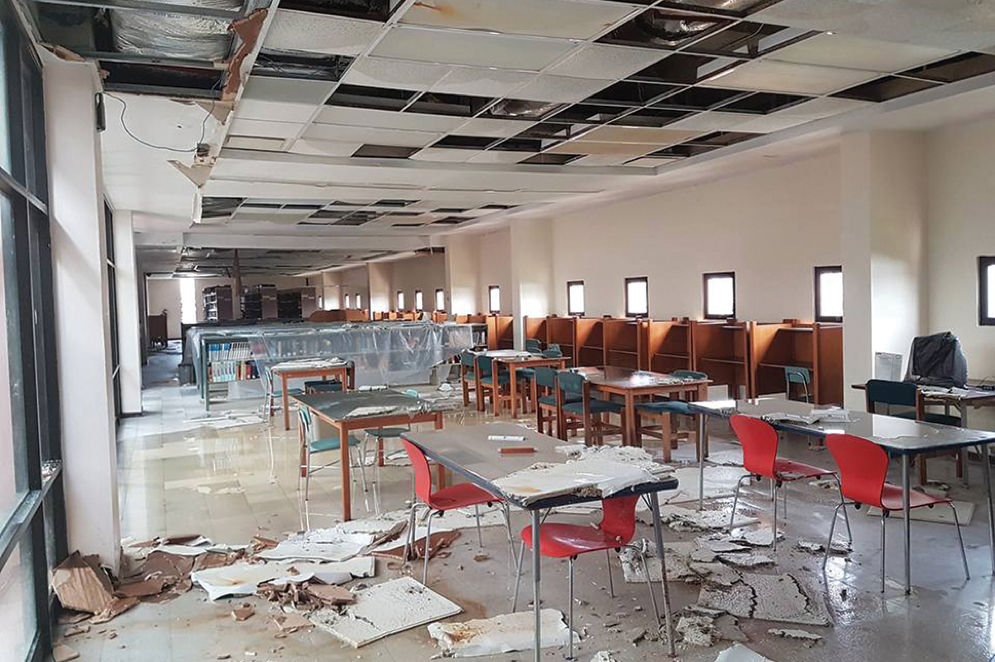
Sharing Our Resources With Puerto Rico

Lucy Campbell and Barbara Opar, Column Editor

Column by Barbara Opar, Librarian for Architecture, Syracuse University Libraries

“Quick question for you. I know that the …Library gets rid of books every year because of space, etc., but I was wondering if there would be a way to give those books to libraries in Puerto Rico that lost everything after Hurricane Maria…. Who could I talk to about this?”


September 2018


So began AASL’s participation in a program to help replace or add to the University of Puerto Rico’s collection of architecture books.  Rather than just send books though, AASL is preparing a list of available titles that will then be shared with librarians and administrators in San Juan. The AASL list is being coordinated by Gilda Santana, the head of the Architecture Library at the University of Miami. She can be contacted via email at gsantana@miami.edu  or reached by telephone at 305)284-5282.


September 2018


AASL is asking fellow librarians as well as faculty to consider helping this cause. With academic libraries being increasingly space challenged, duplicates are indeed being weeded and often sold or discarded. Please consider adding them to the AASL list of titles available to the University of Puerto Rico. Do you get gift books that may be important resources but that duplicate your holdings? Most of us do. Two such gift collections are already being added to the AASL list with the donors delighted that their books are actually needed and will serve a worthy purpose.


Faculty: how many review copies do you get? Textbooks too could help these students. Have duplicates yourself or just no more space at your home or office? Then contact your AASL member librarian or Gilda Santana. These titles can be added to our ongoing list for selection by those in Puerto Rico. DO NOT SEND ACTUAL BOOKS now to ARR. We will present you with various options once a core group of titles has been selected. But for now have the author, title and publication information available for entry into the AASL document. AASL members will be given direct access to the database; other donors will receive instructions on how to proceed.


September 2018


Puerto Rico is slowly emerging from this most recent crisis. But budget crises remain so the AASL project can be of long-term benefit. Review your personal and professional collections as appropriate and see if there are ways that you can improve the education of those students struggling to get access to architectural resources.  You won’t be sorry.


Renovation for Education: Adding Value to the NewSchool Library

AASL Column, February 2018

Column by Lucy Campbell and Kaegan Cusenbary, NewSchool of Architecture and Design

Across the United States, campuses are pouring money into library renovations. From gyms to cafes to makerspaces, we see growing efforts to keep libraries relevant as students diversify their information sources.  These updates are sparked by the changing needs of students and the shifting definitions of academic libraries.  As explored in Library Buildings 2017, “libraries these days are no longer quiet bastions filled with books, if they ever were only that. Libraries today offer beautiful and comfortable common spaces, up-to-the-minute technology…and elegant overall design that makes these institutions anchors in their communities” (p.5). As community hubs, academic libraries can provide spaces that foster creativity and innovation in support of their institution’s educational goals and mission.

The mission of NewSchool of Architecture and Design is to nurture and inspire design-minded students. It endeavors to be a vibrant educational setting where the academic community finds meaning and inspiration in the pursuit of professional goals. However as a downtown school of 500 architecture, design, and construction management students, with a library of just 2,200 square feet, space is at a premium. Although we knew our library needed attention, we recognized its limitations.

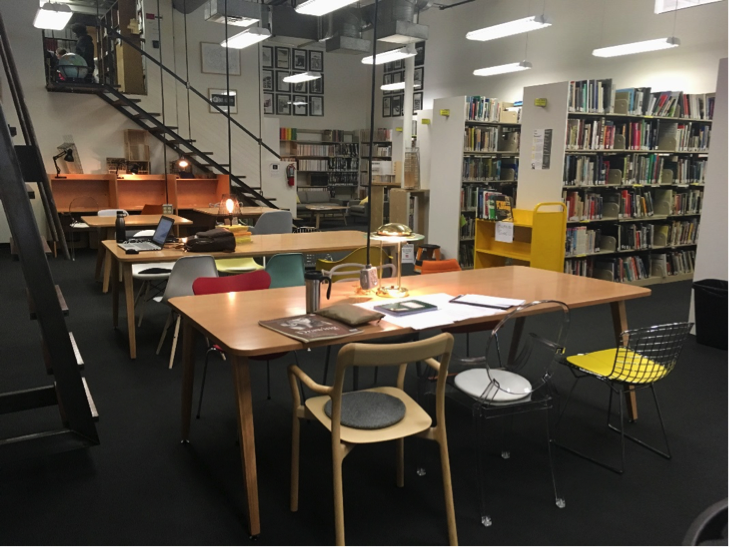
Figure 1. Prior to renovations the library featured wood in every shade

According to Bieraugel & Neil (2017) libraries need to “be mindful of the need for students to have spaces for quiet contemplation and reflection, collaboration and noisy interaction. These are places to observe, question, experiment, and network. To provide high value for students, it is important that academic libraries use their spaces to foster the highest level of…creativity and innovation” (p.50).

As a design school focused on human centeredness and design thinking, we convened a committee of educators and design professionals who began by asking, what do our students need to be successful? One white paper, twelve meetings and innumerable discussions later, we landed on an idea. Instead of simply updating the space, we would integrate an educational element by creating a curated exhibition of celebrated design chairs. Coupled with a fact sheet outlining why each chair was significant to design history, this would serve as an educational tool, while also arguably making ours the hippest library in San Diego.

Choosing the chairs was a fun but formidable task. In addition to style and pedigree, the committee considered practicality, comfort, mobility, and of course space concerns. Some chairs were disqualified for outrageous dimensions, others for being obviously awkward. Balancing comfort and style meant going through six iterations of the chair proposal before all committee members were satisfied. This type of back and forth is time consuming, yet a hallmark of design education. Ultimately the process was hugely valuable to ensuring we had the best chairs possible for our students and our library space.

Figure 2. A curated collection of chairs serve as an educational tool

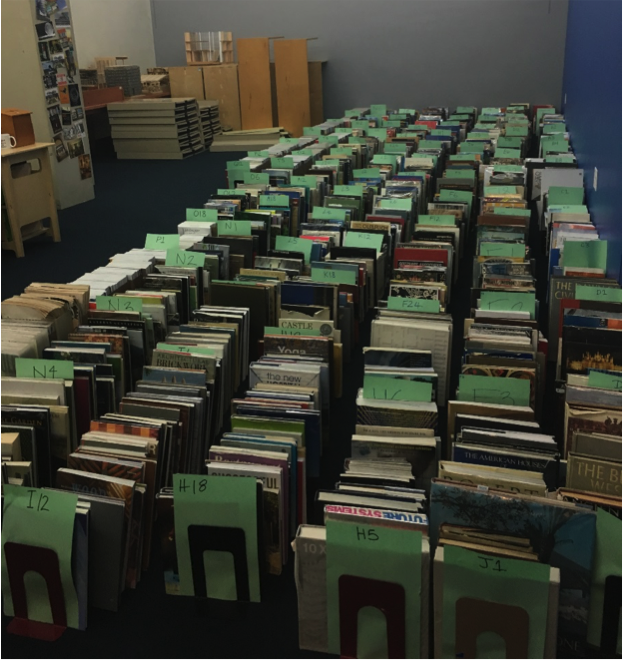
Of course, new chairs alone do not provide the wow factor expected from an expensive update, no matter how stylish they may be. Our committee set their eyes on every non-structural element of the library and, with a budget in mind, began to imagine a space worthy of the new chairs. Everything from carpets and paint down to cushions and corkboards was game. When we finally had a plan in place, there was a lot of moving parts, and a lot of books to move. In just one week during the Christmas Break, half the collection was removed and replaced to allow renovations to take place.

Figure 3. Removing and replacing the collection was a complicated process

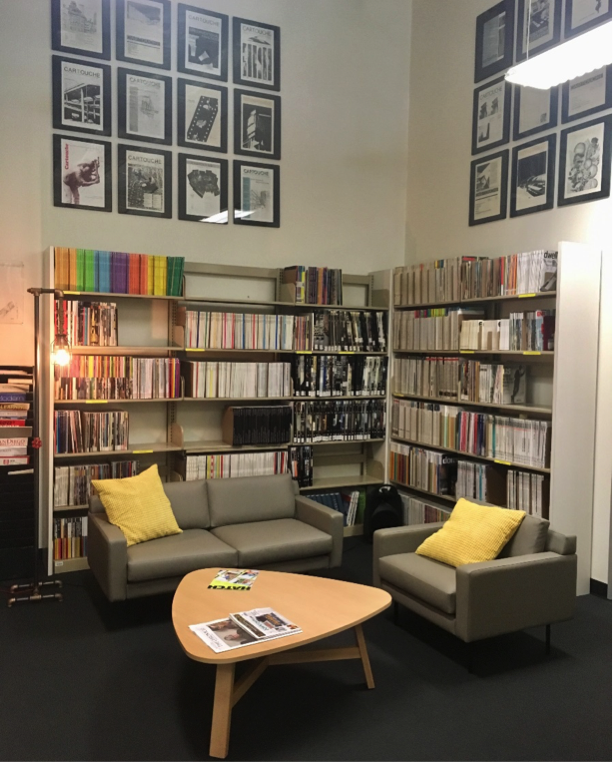
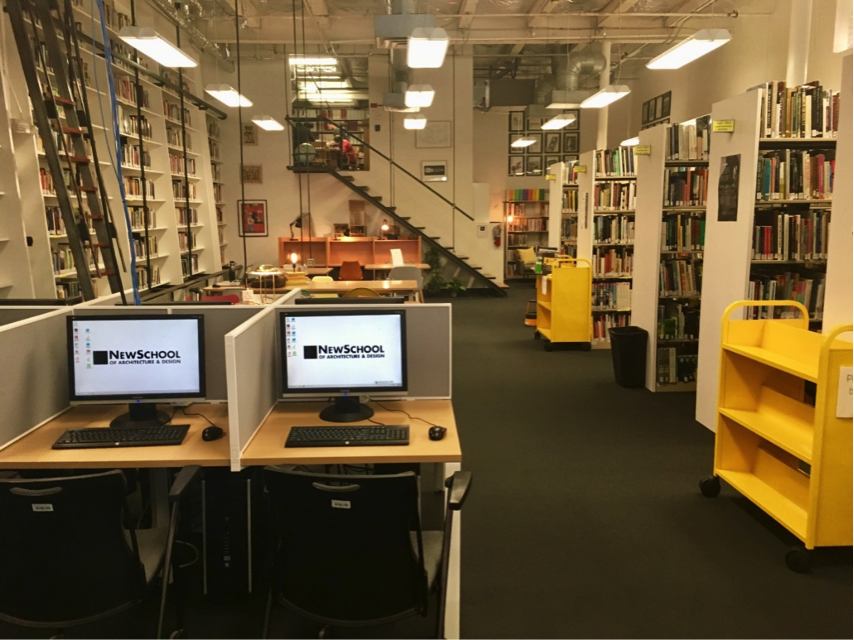
Our old library, with its mismatched furniture and heavy shelving, was not exactly conducive to the multiple environments students need to flourish. We focused on what we could change, maximizing the space and creating brighter, more inviting areas. The first day of the new space, students were already spending more time in the library. They debated their favorite chair and tried to guess which was most expensive. They sat in each, one by one, and snapped pictures. The new layout included group spaces, individual tables and private study carrels to provide the range of options that students really needed.

Figure 4. New spaces provide a variety if study environments

The first step towards encouraging library use is getting new students in the door. Come Fall of this year we will compare new student use and get an idea of the impact our renovation has had. Until then, we can already see students respecting and appreciating the space. The library has been reincarnated from a depository for books and information, to a space students, faculty, staff, and visitors can enjoy while learning and researching. As one student put it “this is a place I’d like to have a party now.”

Figure 5. The updated library is bright and welcoming

References:

Bieraugel, M. m., & Neil, S. (2017). Ascending Bloom’s Pyramid: Fostering Student Creativity and Innovation in Academic Library Spaces. College & Research Libraries, 78(1), 35-52.

Library Buildings 2017. (2018). ILA Reporter, 36(1), 4-17.

The Twelve Books of Christmas

Lucy Campbell and Barbara Opar, column editors
Column by Barbara Opar

We think you will all agree that architects love books. There is still something satisfying about opening a new book for the first time. As you take off the shrink wrap, you look forward to settling down in a comfortable chair and flipping through the pages to revisit old topics or explore new material. There is the anticipation of wondering what images the author has selected and if they will be recognizable to you.  Well, if all you want is a new book to peruse, then here are some suggestions you might give to Santa:

Adjaye, David. David Adjaye: Living Spaces. New York: Thames & Hudson, 2017. ISBN: 978-0500343258. 288 pages. $40.80

A dazzling tour of fifteen contemporary houses designed by David Adjaye, one of the most influential architects of his generation.

Houses or domestic buildings are often among the first projects young architects design. For David Adjaye, such early commissions connected him to a rising generation of creators with whom he shared a range of sensibilities. His artistry, clever use of space, and inexpensive, unexpected materials resulted in many innovative and widely published houses.

After fifteen years of practice and a raft of high-profile projects around the world_including the Smithsonian National Museum of African American History and Culture in Washington, DC_houses represent a smaller portion of Adjaye’s work but are more potent as a result. Selecting projects that are challenging because of their sites, complexity, or architectural possibility, Adjaye has both expanded and sharpened his domestic design, taking it in new directions and to new locations.

This monograph presents the fifteen finest and most recent examples, from Africa to Brooklyn, from desolate farmlands to urban jungles. Chronicled through informed descriptions and detailed and photographically rich visual documentation, the results testify to the importance of Adjaye’s growing inventiveness and provide powerful ideas for residential architecture.

Bendov, Pavel. New Architecture New York. New York: Prestel, 2017. ISBN: 978-3791383682. 224 pages.  $30.59

A magnificent photographic compilation of New York City’s best new architecture, this book features projects by leading firms working today. From Bjarke Ingels Group’s VIA West 57 to SHoP Architects’ Barclays Center, and from Diller Scofidio + Renfro’s High Line to SOM’s One World Trade Center, New York City has been home to some of this century’s most exciting new architecture. Profiling more than fifty projects that are shaping the city’s streets and skylines, this book features color photographs of each building and a brief, informative text about its significance. Renzo Piano Building Workshop, Ateliers Jean Nouvel, Foster + Partners, Selldorf Architects, Gehry Partners, and Adjaye Associates are just some of the firms that have recently completed projects in New York City. Visitors to the city as well as its denizens will find this book an exhilarating guide, while fans of architecture will gain an even greater appreciation of the city’s unprecedented development in the past fifteen years by the world’s best architects.

Emden, Cemal. Le Corbusier: The Complete Buildings. Munich: Prestel, 2017. 978-3791384023. 232 pages. $31.42

This visual tour of every one of Le Corbusier’s buildings across the world represents the most comprehensive photographic archive of the architect’s work. In 2010, photographer Cemal Emden set out to document every building designed by the master architect Le Corbusier. Traveling through three continents, Emden photographed all the 52 buildings that remain standing. Each of these buildings is featured in the book and captured from multiple angles, with images revealing their exterior and interior details. Interspersed throughout the book are texts by leading architects and scholars, whose commentaries are as fascinating and varied as the buildings themselves. The book closes with an illustrated, annotated index. From the early Villa Vallet, built in Switzerland in 1905, to his groundbreaking Unité d’Habitation in Marseille, completed in 1947, this ambitious project presents the entirety and diversity of Le Corbusier’s architectural output. Visually arresting and endlessly engaging, it will appeal to the architect’s many fans, as well as anyone interested in the foundation of modern architecture.

Glancey, Jonathan. What’s So Great About the Eiffel Tower?: 70 Questions That Will Change the Way You Think about Architecture. London: Laurence King Publishing, 2017. ISBN: 978-1780679198. 176 pages. $12.80

Why do we find the idea of a multi-colored Parthenon so shocking today? Why was the Eiffel Tower such a target for hatred when it was first built? Is the Sagrada Família a work of genius or kitsch? Why has Le Corbusier, one of the greatest of all architects, been treated as a villain?

This book examines the critical legacy of both well known and either forgotten or underappreciated highpoints in the history of world architecture. Through 70 engaging, thought-provoking, and often amusing debates, Jonathan Glancey invites readers to take a fresh look at the reputations of the masterpieces and great architects in history. You may never look at architecture in the same way again!

Goldberger, Paul. Building Art: The Life and Work of Frank Gehry. New York: Vintage, 2017. ISBN: 978-0307946393. 544 pages. $13.49

Here, from Pulitzer Prize–winning critic Paul Goldberger, is the first full-fledged critical biography of Frank Gehry, undoubtedly the most famous architect of our time. Goldberger follows Gehry from his humble origins—the son of working-class Jewish immigrants in Toronto—to the heights of his extraordinary career. He explores Gehry’s relationship to Los Angeles, a city that welcomed outsider artists and profoundly shaped him in his formative years. He surveys the full range of his work, from the Bilbao Guggenheim to the Walt Disney Concert Hall in L.A. to the architect’s own home in Santa Monica, which galvanized his neighbors and astonished the world. He analyzes his carefully crafted persona, in which an amiable surface masks a driving ambition. And he discusses his use of technology, not just to change the way a building looks, but to revolutionize the very practice of the field. Comprehensive and incisive, Building Art is a sweeping view of a singular artist—and an essential story of architecture’s modern era.

Mayne, Thom. 100 Buildings. New York: Rizzoli, 2017. ISBN: 9780847859504. 264 pages. $17.00

For this volume, over forty internationally renowned architects and educators—from Peter Eisenman and the late Zaha Hadid to Rafael Moneo and Cesar Pelli—were asked to list the top 100 twentieth-century architectural projects they would teach to students. The contributors were encouraged to select built projects where formal, spatial, technological, and organizational concepts responded to dynamic historical, cultural, social, and political circumstances. The capacity of these buildings to resist, adapt, and invent new typologies solidifies their timeless relevance to future challenges.

Olonetzky, Nadine. Inspirations: Time Travel Through Garden History. Basel: Birkhauser Architecture, 2017. ISBN: 978-3035613841. 206 pages. $39.99

Every garden is an imagined paradise – a garden paradise that incorporates the personality of the individual who created it, but also the long history of horticulture.

The book recounts the history of gardens from their likely origins in Mesopotamia to today; in chronological order and in sections with keywords, it introduces the most important styles as well as the people that have influenced developments in Europe.

Although the famous and influential gardens often needed extensive funds for their creation, gardens are not designed for the privileged of this world. Whether it is an allotment, a landscape park, a cemetery, or a city park – small and large gardens interweave with the built landscape and are an inspiration for all of us.

Paul, Stella. Black: Architecture in Monochrome. New York: Phaidon Press, 2017. ISBN: 9780714874722. 224 pages. $37.84

A stunning exploration of the beauty and drama of 150 black structures built by the world’s leading architects over 1,000 years. Spotlighting more than 150 structures from the last 1,000 years, Black pairs engaging text with fascinating photographs of houses, churches, libraries, skyscrapers, and other buildings from some of the world’s leading architects, including Mies van der Rohe, Philip Johnson, and Eero Saarinen, David Adjaye, Jean Nouvel, Peter Marino, and Steven Holl.

Rau, Cordula. Why Do Architects Wear Black? Basel: Birkhauser Architecture, 2017. ISBN: 9783035614107. 260 pages. $22.99

Why is it really that architects wear black?” was a question put to Cordula Rau by an automotive industry manager during an architectural competition. Even though she herself is an architect, and wears black, she did not have an answer on the spot. So she decided to ask other architects, as well as artists and designers. She has been collecting their handwritten replies in a notebook since 2001.

In 2008, this collection of autographs appeared as a small publication – obviously bound in black. For the purpose of the new edition, this legendary collection was expanded by new notable, amusing, pragmatic, and quirky reasons: “Please read it and don’t ask me why architects wear black!”. (Cordula Rau)

Ryan, Zoe. As Seen: Exhibitions that Made Architecture and Design History. Chicago: Art Institute of Chicago, 2017. ISBN: 978-0300228625. 144 pages. $30.49

Exhibitions have long played a crucial role in defining disciplinary histories. This fascinating volume examines the impact of eleven groundbreaking architecture and design exhibitions held between 1956 and 2006, revealing how they have shaped contemporary understanding and practice of these fields. Featuring written and photographic descriptions of the shows and illuminating essays from noted curators, scholars, critics, designers, and theorists, As Seen: Exhibitions that Made Architecture and Design History explores the multifaceted ways in which exhibitions have reflected on contemporary dilemmas and opened up new processes and ways of working. Providing a fresh perspective on some of the most important exhibitions of the 20th century from America, Europe, and Japan, including This Is Tomorrow, Expo ’70, and Massive Change, this book offers a new framework for thinking about how exhibitions can function as a transformative force in the field of architecture and design.

Stech, Adam Sally Fuls and Robert Klanten.; Inside Utopia: Visionary Interiors and Futuristic Homes. Berlin: Gestalten, 2017. ISBN: 9783899556964. 288 pages. $46.91Top of Form

Spectacular and reflective, unpretentious and efficient: the breathtaking Elrod House by John Lautner; the Lagerfeld Apartment near Cannes that seems like a set from a science fiction film; Palais Bulles in France with its organic and unique architecture. These interiors welcome habitation and spark curiosity while embodying the foundations of minimalism and bygone visions of the future. Inside Utopia delves into the rhyme and reason behind past designs that we still interact with today.

The architects, the owners, and the craftsmen like Gio Ponti or Bruce Goff who work behind the scenes created amorphous interiors that invite the mind to wander. At the time they were futuristic, confident, utopian, idealistic— we may not realize it, but they have shaped our current living concepts, and even now, they inspire us anew. Previously it has been difficult to attain access to these preserved interiors, but Inside Utopia unearths what was before unseen.

Yeang, Ken. It’s Not Easy Being Green. Novato: ORO Editions, 2017. ISBN: 978-1939621863. 100 pages.  $25.23

It’s Not Easy Being Green, literally tells the reader that the idea of ‘Green architecture’ is not as simple as many expected. It’s not solely about energy efficiency or putting out different levels of vegetation, but it is an extensive dedication and cautious action towards natural and built environment. Ken’s work has demonstrated a comprehensive set of strategies making Green Architecture feasible and practical for architects and professionals from other fields to understand the importance of saving the world from environmental devastation. The book intends to raise awareness and concern on environmental issues, and suggests ways of how architecture can be design now in favor of a benign living environment.

See anything you like? Hope so! Obviously this list is just a small sampling of newly released titles and many of you may have specific ideas about the books you want to add to your collections. But if you need further suggestions, take a look at your library’s new book display or site. You can even ask your subject librarian! Either way, enjoy a little downtime with your favorite new book.