
The Perspective from Seattle

by Marilys Nepomechie
2015-16 ACSA President

A confluence of forces, external and internal, creates the context in which our academic programs advance research, engage communities, and deliver an education in architecture. The reset effected by a worldwide economic downturn that, despite gains, continues to reverberate, has re-focused energy on innovation, entrepreneurship, performance, and productivity. It has done so even while heightening our awareness of a profound global interdependence, of world-wide environmental vulnerabilities, and of the myriad ways in which we are collectively diminished by broad and persistent disparities in access, in income, and in the conditions essential to health and well-being.

Out of that context grows a sharpened awareness of the centrality of research and scholarship to advancement in the academy, in the profession, and in all aspects of practice; of the outsize power that resides in cultivating diversity, and leveraging a plurality of voices, capacities and disciplinary perspectives in the course of our work; and on the necessity to exercise our disciplinary skills in collaborative, reciprocal relationship to our counterparts across borders in the academy and in the profession.

Charges to Board Committees and Task Forces

Over the past months, I have engaged the committees of the ACSA Board to address these conditions through actions that affect the governance structure of the organization, as well as its programming and management activities. These charges have sought to initiate programs and build upon successful ongoing initiatives that express our core values, help frame potential new directions and opportunities for action, and position the organization at the heart of information, innovation, and engagement within our international and multi-collateral contexts.

A joint charge to the Board’s Publications, Awards, and Scholarly Meetings Committees asked members to embark on ambitious programs to assess and grow the number of ACSA instruments and venues for the dissemination of faculty production, including publications, presentation, and exhibitions. 

Presidential task forces have focused on leveraging the growing digital capacity of the organization in multiple spheres: To enhance ACSA’s role in facilitating and advancing peer-reviewed research and scholarship, both in North America and internationally; to stake out a position of influence in the critical arena of program rankings and academic metrics; and to continue to assist programs in their recruitment efforts.

ACSA has convened an International Task Force with representatives from each of the collateral organizations—AIA, NCARB, AIAS, and NAAB—to begin shaping an international agenda for ACSA, raising its profile beyond North America and leveraging its existing programs and organizational strengths to facilitate collaborative international opportunities for faculty, students, and professionals across geographic, cultural, and national borders. As in the area of research, the international task force has worked collaboratively with the collateral participants to attain mutual advancement.

Strategic Plan and Governance

Understanding that significant accomplishment requires a clear and holistic articulation of values and goals, the board’s Planning Committee, led this year by President Elect Bruce Lindsey, has concluded its 2-year strategic planning process.  For the first time in over a decade, and with broad member input, the ACSA has produced a new organizational statement of its desired future. 

Equally important to its ability to undertake and fulfill an ambitious agenda, is a board governance structure that supports greater productivity, and includes broad member participation. A multi-year process that resulted last fall in member approval of a longer presidential ladder, continues this year with the creation of three new governance committees whose work will inform and advance the activities of the board. 

Path Forward with NAAB

Our ongoing work with our collateral organizations on the governance and funding of NAAB has entered a new phase, as we continue our efforts to create a more equitable and affordable accreditation process: one that grows representation on its governing board for educators; that cabins its expenses, bringing them to closer parity with the accreditation processes of comparable disciplines; and one that opens avenues for greater coordination with our collateral partners around our shared interests in sustaining the growth and development of the continuum of architectural education, from K-12 through collegiate, internship, and continuing education. The Board has devoted a significant amount of time to advance these goals, as they affect our members significantly.

Other Collateral Collaborations

Beyond our participation in the joint collateral Path Forward task force, ACSA maintains close, active, and productive ties with AIA, AIAS, NAAB, and NCARB. This range of engagements joins the voices of educators to those of the profession, regulation, students, and emerging professionals. Our leadership in these efforts advances architectural education and research and, in so doing, benefits our members.

With NCARB we have exchanged committee liaisons. ACSA West Central Director Nadia Anderson served on the NCARB Integrated Path Evaluation Committee, along with other educators, and she will soon transition to become our representative on the NCARB Education Committee. Northeast Director John Cays has served for two years on the Internship Advisory Committee. We were pleased to have NCARB Board Member Kristine Harding serve on our International Task Force this year and participate in the Administrators and Collateral Track at the International Conference in Santiago, Chile, this summer.

ACSA is a participant on a NAAB Accreditation Process Review Task Force. Christine Theodoropoulos, CalPoly, San Luis Obispo, agreed to serve on behalf of the Board. NAAB Director Helene Combs Dreiling serves on the ACSA International Task Force, and NAAB Director Tamara Redburn will lead a session on international accreditation as part of the Administrators and Collateral Track of the International Conference.

ACSA is pleased to have the vice president of AIAS as a Student Director on our Board. Joel Pominville was an active and persuasive participant in board committees, discussions, and juries. We were also able to involve AIAS board member Rachel Law in the International Task Force, soon before she was elected 2016-17 AIAS Vice President. Greg Hall, Mississippi State University, will be ending a two-year term as ACSA liaison on the AIAS Board of Directors. Carmina Sanchez del Valle, Hampton University, will continue Greg’s work in facilitating collaboration and dialogue between the organizations. 

Finally, under collateral relationships, several partnerships with the AIA have created opportunities for our members. We are partnering for the second year in the upcoming Intersections Symposium during the AIA National Convention in Philadelphia, a conference/workshop intended to highlight research that informs architectural practice. This partnership will continue in coming years, affording more peer-reviewed opportunities for faculty to showcase their research.

We continue our work as partners with AIA and the Architects Foundation on the Design and Health Research Consortium and on the National Resilience Initiative, each of which has identified a number of member schools to advance research and teaching agendas in areas of critical importance for the profession.

AIA 2017 President and UIA Secretary General Thomas Vonier is a member of the ACSA International Task Force, and is working with us to organize the Administrators track in Santiago, Chile. We took the opportunity to work with the AIA Housing and Community Development Knowledge Community to co-organize a workshop at the beginning of the 104th Annual Meeting. Our thanks to Kathy Dorgan and Etty Epadmodipoetro for collaborating with us on an outstanding preconference housing workshop. 

Conferences and Competitions

Between the Autonomous and Contingent Object, the 2015 Thematic Fall Conference, was hosted in October by Syracuse University. Co-chaired by professors Roger Hubeli and Julie Larsen, the conference focused on architectural theory and discourse, employing a provocative format structured around a series of debates. Selected papers form the core of the inaugural issue of the Plan, a new theory journal.

Uncharted Territories, the 2015 Administrators Conference, was co-chaired by deans Patricia Belton Oliver, University of Houston and Francisco Javier Rodriguez, Universidad de Puerto Rico. It was hosted by the University of Puerto Rico in San Juan and challenged administrators to address the plethora of new realities that increasingly define our work in the academy 

The 104th Annual Meeting was titled Shaping New Knowledges. Co-chairs Sharon Haar, University of Michigan and Robert Corser, University of Washington graciously accepted my suggestion that the conference focus on the multiple modalities and products of architectural research currently underway at member schools. Hosted by the University of Washington, the conference offered a window on the impressive range of exploration collaborative practices in which our colleagues — in the academy and in practice — are presently engaged.

Cross-Americas: Probing Disglobal Networks is the title of the upcoming 2016 International Conference, to be held next June in Santiago, Chile. Focused on global discourses in architectural practice and research, the bi-annual conference will be hosted by the Pontificia Universidad Católica de Chile. It is co-chaired by [from north to south] Vera Parlac, University of Calgary, Alberta, Canada; Dana Cupkova, Carnegie Mellon University, Pennsylvania, USA; Alfredo Andia, Florida International University, Florida, USA; and Umberto Bonomo and Macarena Cortes, Pontificia Universidad Católica de Chile, Santiago, Chile. Confirmed keynote speakers include Alejandro Aravena, winner of this year’s Pritzker Prize and curator of the upcoming Venice Biennale.

This year, for the first time, ACSA has introduced an International Administrators and Collateral Track within the program of the academic conference. Co-chaired by Emilio de la Cerda, Pontificia Universidad Católica de Chile, Santiago, Chile, and Roger Schluntz, University of New Mexico, the Administrators Track includes sessions on international NAAB accreditation; transitions from the academy to practice in an international context; post-professional education across borders; and international study, internship, and practice. 

We invite you to participate in the critical discussions on every aspect of education and practice, and encourage academic faculty, program administrators, and professionals to attend this multi-national discussion. 

Finally, selected by the ACSA Board at the close of spring 2015, and focusing on research in design and health, the upcoming 2016 Fall Conference will be the first jointly offered by ACSA and the Association of Schools and Programs of Public Health (ASPPH). Titled Building for Health and Well-Being: Structures. Cities. Systems, the meeting will bring together academics, practitioners, and policy makers to focus on research at the intersection of design, the built environment, and public health. The University of Hawaii at Manoa School of Architecture will host the meeting co-chaired by Sara Jensen Carr, University of Hawaii, Billie Faircloth, KieranTimberlake, and Howard Frumkin, University of Washington School of Public Health.

This year’s ACSA competitions cover a range of materials and areas of design focus. Tall Buildings is the focus of the 16th ACSA/American Institute of Steel Construction student design competition, a staple for many faculty in North America. The Binational Softwood Lumber Council returns as a sponsor for Timber in the City: Urban Habitat Competition, with a mixed-use program that includes an outpost of the Andy Warhol Museum. Two AIA committees are partners for separate competitions. Last year the AIA Committee on the Environment expanded its renown COTE Top Ten competition to include students. The AIA Historic Resources Committee also continues the biannual Preservation as Provocation competition with a design challenge for a new visitor center at the Farnsworth House.

Thanks in Conclusion

It has been a year filled, I hope you will agree, with accomplishment. It is an honor to serve on behalf of ACSA with dedicated colleagues and a truly outstanding staff led by Michael Monti. The ACSA Board of Directors is a committed group of volunteers who have devoted a great deal of time to advancing the mission of the ACSA.

We were saddened to learn recently of the death of Norman Millar, member of the ACSA Board of Directors from 2012-2015, and its 2013-14 President. Dean of Woodbury University, Norman was a long-time colleague and valued friend. The architectural community is diminished by his absence. 

– Marilys Nepomechie

University of Southern California

Douglas Elliman Real Estate and Development recently celebrated the Grand Opening of their new California Headquarters. Patrick Tighe Architecture had the privilege of designing the 11,000 square foot environment located on 2 floors of the iconic 150 El Camino building in Beverly Hills. North Beach is a new park and playground designed by Patrick Tighe Architecture for the city of Santa Monica, The project has received all approvals from the city and is scheduled for a 2016 construction start date. The universally accessible park and playground is located on an acre parcel along the bike path, north of the Santa Monica pier. 

Dr. Travis Longcore (Landscape Architecture + Urbanism program) was a workshop presenter at LightFair Institute at LightFair 2016.  The course, Nighttime Lighting Blues: Juggling Needs of People and Critters, was co-taught with Ian Ashdown (Lighting Analysts Inc.) and Naomi Miller (US Department of Energy).  Dr. Longcore also advised two students in the USC Undergraduate Research Symposium, where their poster, Park Light: A Framework to Monitor Nighttime Upward Radiance From and Near National Parks, won awards both for physical sciences and for policy.  The research project was also awarded funding from the USC Provost’s office as part of the Undergraduate Research Associates Program.  

Karen Kensek and Douglas Noble helped Prof. Jae Yong Suk of the University of Texas at Austin (UTSA) to organize the FAÇADE TECTONICS FORUM in San Antonio in April.  Speakers included Hazen Rashed-Ali (UTSA), Douglas Melnick (City of San Antonio), Hayden McKay (HLB Lighting Design, Matt Fajkus (Univ of Texas at Austin), Jae Yong Suk (UTSA), Kevin McClellan (Tex-Fab), James Warton (HKS) and John Houser (Gensler).

Jennifer Siegal has won the arcVision Prize – Women and Architecture, an international award to women’s architecture organized by Italcementi. The winner was described by the jury as “a fearless pioneer in the research and development of prefabricated construction systems, at low prices for disadvantaged users and areas, who has been able to invent and build practical solutions and a new language for mobile and low-cost housing”.

Geoffrey von Oeyen presented a Spring 2016 Baumer Lecture titled “Geoffrey von Oeyen Design: Site, Sight, and Sailing” in Knowlton Hall’s Gui Auditorium on Wednesday, March 30, 2016, at the Austin E. Knowlton School of Architecture at the Ohio State University.

Lisa Little was an invited juror for the College of Architecture and Environmental Design at Cal Poly, San Luis Obispo’s annual Best of Show reviews.

Assistant Professor Alvin Huang has been invited to give a public lecture and participate as a guest juror in the event “Ciudad de Dymaxion: Fuller en Mexico” at the Museo Tamayo in Mexico City from April 15-18. Professor Huang will speak about the influence of Buckminster Fuller in his own work, and review a series of constructed abstractions of Fuller’s approaches produced by students of Universidad Iberoamericano in the course “Corrupting Fuller” led by Professor Pablo Kobayashi.  Professor Huang will also participate as an external reviewer in the Colloquium of final research projects presented by Master of Design Studies degree candidates in the Technology Concentration (coordinated by Allen Sayegh and Bradley Cantrell) at the Harvard Graduate School of Design on Wednesday, May 11.

Eric Nulman recently joined the Board of Directors of the Los Angeles Forum for Architecture and Urban Design (www.laforum.org). The Los Angeles Forum for Architecture and Urban Design is an independent nonprofit organization that instigates dialogues on design and the built environment through public programming, exhibitions, and publications. Eric is on a five-year appointment, serving through 2020.

The Courtyard at La Brea building (photo) by John Mutlow, FAIA, and Patrick Tighe has been nominated for the Mies Crown Hall Americas Prize by the College of Architecture at Illinois Institue of Technology.  The objective of the MCHAP is to reward contemplation of the intersection of the new metropolis and human ecology,” says the school.  There is an outstanding group of nominees for this distinguished prize.

Check them out on StudyArchitecture!

Woodbury University Dean and Past ACSA President Norman Millar Has Passed Away

It is with great sadness that we share the passing of Norman Millar, our friend, former ACSA president, and dean of the Woodbury University School of Architecture, on April 14 due to complications from surgery, following his diagnosis of pancreatic cancer. Norman co-chaired the Administrators Conference in 2011 and served on the Board of Directors from 2012 to 2015, including as ACSA president in 2014-15.
 
Norman was an optimistic proponent of change to improve architectural education. He was passionate about inspiring students to join the architecture community, demonstrated through his leadership in growing the program at Woodbury University. Those efforts attracted a cover story by Architect magazine in 2011 about Woodbury University and the increasingly diverse populations of students entering architecture school.
 
As ACSA president, Norman advocated for collaboration and equity. He challenged ACSA, and the nation’s major architecture organizations, to seek new models for support of architectural education. He helped to shape initiatives that have helped students to graduate and become architects more quickly. Within the ACSA Board of Directors, he brought a vision for the organization that valued diverse forms of research and scholarship and encouraged board members, and our numerous volunteers, to find ways to collaborate and increase the impact that architecture schools can have on their communities.
 
Architect’s Newspaper, Contract magazine, and Archinect have published obituaries that honor Norman’s career.

In lieu of flowers, donations can be made to the Norman R. Millar Endowment for the School of Architecture at Woodbury University.

University of Texas at Austin

This summer, after fifteen years of dedicated service to The University of Texas at Austin, Dean Fritz Steiner will be leaving the School of Architecture to serve as dean of PennDesign at the University of Pennsylvania, his alma mater. Elizabeth Danze, UTSOA professor and Associate Dean of Graduate Programs, will serve as interim dean for the school effective July 1. 

Assistant Professors Kory Bieg and Clay Odom won the FIU Emerging Architect’s Initiative to design a rooftop canopy for the Bernard Tschumi designed FIU School of Architecture building.__ Kory Bieg also won the Field Constructs Design Competition for his project Hybroot, which was installed in the Circle Acres Nature Preserve in Austin last fall.__

Matt Fajkus, Assistant Professor and principal architect of Matt Fajkus Architecture, has been invited to speak at the Façade Tectonic: Forum San Antonio on April 7th. _

Assistant Professor Petra Liedl served as editor of the recently-published, bilingual (English and German) book, EnergyXChange: Munich and Austin As Regional Centers for Sustainable Innovation, and organized a symposium of the same name as part of her Donald Harrington Faculty Fellowship in 2012- 2013.__

Gabriel Díaz Montemayor gave a lecture entitled, “Service Studios: Public Space and Academia,” at the VII International Congress on Architecture and Design organized by the Marista University of Merida in the state of Yucatan, Mexico. Montemayor also presented a paper, “Hybrid Ecological and Sustainable Mobility Networks for Northern Mexico,” at the 46th Urban Affairs Association Conference held in San Diego 

_Steven Moore, Co-Director of the Graduate Program in Sustainable Design, recently delivered the keynote address at the Annual Doctor of Design, DDes Symposium at the Harvard Graduate School of Design.

Allan Shearer, Co-Director of the Center for Sustainable Development, authored “Abduction to Argument: A Framework of Design Thinking,” for the current issue of Landscape Journal.__

Professor Wilfried Wang guest-edited two consecutive issues of the Japanese architectural journal A+U, on the work of Sigurd Lewerentz. Wang also co-curated, with Adjunct Associate Professor Barbara Hoidn, the upcoming exhibition,DEMO:POLIS–The Right to Public Space, at the Akademie der Künste, Berlin.

Call for Nominations: ACSA Committees

The ACSA Board of Directors invites nominations and self-nominations to participate in 2016-2017 ACSA committees and task forces. Faculty at ACSA full and candidate member schools are encouraged to participate in activities designed to strengthen architectural education.

At the 2016 Annual Meeting, the ACSA Board approved a second phase in its governance review process. To begin implementation, the ACSA plans to reorganize its board committees in 2016-17 around three new “program committees,” each comprised of 4–6 at-large members and 2–3 ACSA board members. With these committees the ACSA Board intends to expand involvement of ACSA members in addressing strategic issues facing architecture schools. 

The three program committees are charged as follows:

  • The Scholarship & Awards Committee is charged with leading ACSA’s efforts to support faculty in scholarly endeavors; monitoring and assessing peer-review and recognition programs; and recommending actions to advocate for architectural scholarship. The committee is responsible for policies guiding scholarly conferences, journals, and awards.
  • The Education Committee is charged with leading ACSA’s efforts to improve the effectiveness of architectural education through best practices and overseeing programs to cultivate and disseminate these best practices. The committee is responsible for policies guiding the ACSA Teachers Seminar, workshops, and webinars. 
  • The Leadership Committee is charged with leading ACSA’s efforts to support the strategic development of architecture programs; identifying and disseminating best-practice models of program leadership and administration; and overseeing ACSA’s efforts to promote awareness of architectural education. The committee is responsible for policies guiding the Administrators Conference, student recruitment efforts, and data collection and analysis.

Appointments to committees are initiated by the 2016-17 ACSA president, Bruce Lindsey. Appointments are for one year beginning July 1, 2016, and are eligible for renewal thereafter. 

Committees will work primarily through conference calls during the academic year. A funded meeting is planned for committees in fall 2016, and committees may convene at the 2017 Annual Meeting in Detroit.

More information about ACSA’s governance plan and strategic plan are available on the ACSA website.

Interested participants are asked to submit a 1–2 page cover letter identifying areas of interest related to ACSA’s committees and strategic plan, as well as a 2 page (maximum) curriculum vitae. The deadline for nominations and self-nominations is May 3, 2016. Submit materials to Allison Smith, asmith@acsa-arch.org.


University of Buffalo

Shannon Bassett, Assistant Professor of Architecture & Urban Design, presented her design research “Back to the Countryside! – reconfiguring rural-urban typologies, recovering China’s agricultural and ecological landscapes” at the Annual Conference of the Urban Affairs Association in San Diego. Professor Bassett also served as moderator for the session “Urban Environment and Sustainable Development in Asia”

Shannon Bassett presented a paper entitled “ Beyond Inert Sites – scoping the urban landscape & re-calibrating architectural narratives through the shaping of new urban knowledge in architectural education” at the 2016 ACSA national conference in Seattle. The paper was presented in the session “Urban knowledge in architectural education.” 

“He, She & It” – a new building for artists in Buffalo designed by clinical assistant professor Stephanie Davidson and Assistant Professor George Rafialidis, received the 2016 Architizer A+ Award in the Architecture + Workspace category. The project was selected from entries from over 100 countries. Architizer A+ submissions were judged by an international jury that included Winy Maas, Jeanne Gang, Sou Fujimoto and Bjarke Ingels.

Georg Rafialidis, Assistant Professor of Architecture, was awarded a SMART CoE (Sustaianble Manufactirung and Robotic Technologies Community of Excellence) exploratory grant for his work on corbelled structures. He presented this research at the 2016 ACSA national conference in Seattle. 

Jin Young Song, Assistant Professor of Architecture – Assistant Professor of Architecture Jin Young Song’s High Living was the 2016 A+Award Jury Winner in the Unbuilt Residential category. 

http://awards.architizer.com/public/voting/?cid=95 

The project designed by Assistant Professor Jin Young Song and Ludovico Centis(UB School of Architecture & Planning Banham Fellow 2013-14) Hotel Ascension was selected as a finalist of AZURE magazine’s 2016 AZ AWARDS.

Collaborators: Thomas Bittner (Photography), Uros Vukovic, Matthew Rosen

http://www.azuremagazine.com/article/2016-az-awards-meet-the-finalists/

Assistant Professor Jin Young Song’s façade research has received support from the SMART Exploratory funding program. The design team consists of: Jin Young Song (Department of Architecture), Haiqing Lin (Department of Chemical and Biological Engineering), Jongmin Shim (Department of Civil, Structural and Environmental Engineering)

www.buffalo.edu/smart

Brian Carter, Professor of Architecture, served as external examiner of the graduate program in architecture at Dalhousie University in Spring, 2016.

Check out University of Buffalo’s page on StudyArchitecture!

Illinois Institute of Technology

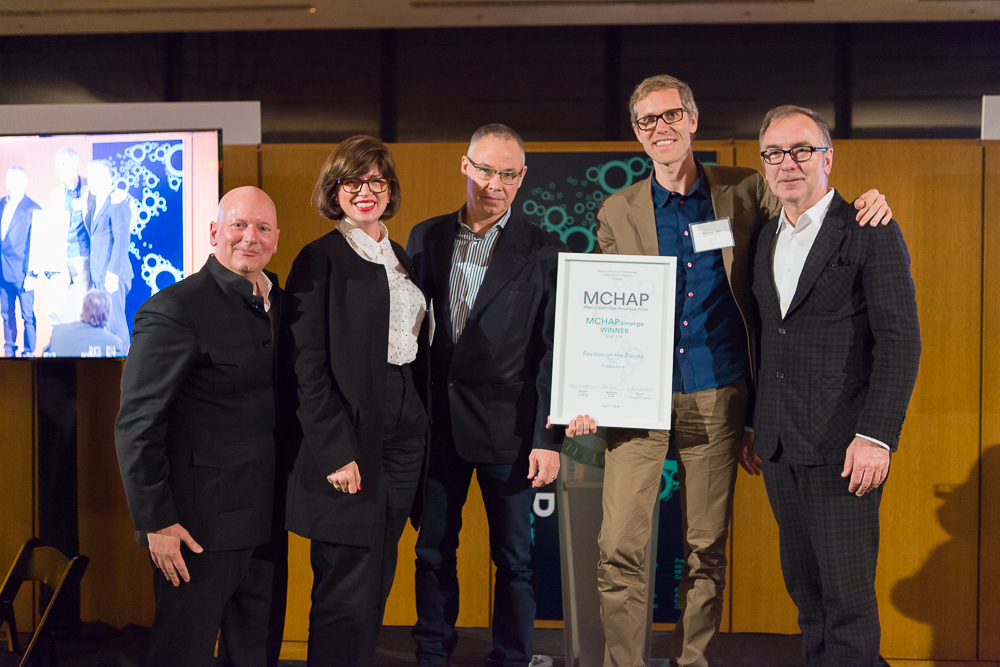
Photo Caption: Left to Right: MCHAP Director Dirk Denison, Jury Member Florencia Rodriguez, Jury President Stan Allen, MCHAP.emerge winner Wonne Ickx representing Productora, Jury Member Dean Wiel Arets.


MCHAP.emerge 2014/15 WINNER ANNOUNCED


Award for Emerging Architecture Goes to Pavilion on the Zocalo; Mexico City, Mexico by Productora

Chicago, Illinois – April 4, 2016 – Illinois Institute of Technology (IIT) College of Architecture Dean Wiel Arets, Mies Crown Hall Americas Prize (MCHAP) 2014/15 Jury President Stan Allen, MCHAP 2014/15 Juror Florencia Rodriguez, and MCHAP Director Dirk Denison announced the MCHAP.emerge 2014/15 Winner, Pavilion on the Zocalo; Mexico City, Mexico; Productora, at the April 1, 2016 MCHAP.emerge Symposium and Award Dinner at S. R. Crown Hall, the home of IIT College of Architecture.

The authors of the winning project, represented at the MCHAP.emerge Symposium by Wonne Ickx, will be recognized with the MCHAP.emerge Award, the MCHAP Research Professorship in the College of Architecture at Illinois Institute of Technology for the 2016/17 academic year, and funding of up to $25,000 USD in support of research and a publication related to the theme of “Rethinking Metropolis.”

The MCHAP.emerge 2014/15 Symposium included afternoon sessions during which the practices of the finalist projects presented their work and engaged in substantive discussions with the jury, the IIT Architecture faculty and student body, as well as the larger MCHAP Network and Chicago architecture community. In addition to Pavilion on the Zocalo; Mexico City, Mexico; Productora, the MCHAP.emerge 2014/15 Finalists included:

C.I.D.; Road to Ayquina, Chile; Emilio Marin & Juan Carlos Lopez Arquitectos

Haffenden House; Syracuse, United States; Jon Lott, PARA Project

OZ Condominiums; Winnipeg, Canada; 5468796 Architecture

San Francisco Building; Asunción, Paraguay; Jose Cubilla & Asociados

The MCHAP.emerge 2014/15 Finalists were selected by the MCHAP 2014/15 Jury from among the 55 MCHAP.emerge 2014/15 NOMINATED WORKS of architecture in the Americas, realized between January 2014 and December 2015, which have been put forward by 95 nominators from throughout the Americas. Nominations were received in January and February and were included in the MCHAP 2014/15 Exhibition held at S. R. Crown Hall on March 4th and 5th at which time the jury held its first jury session.

The MCHAP 2014/15 Jury includes Jury President Stan Allen, architect and former Dean of Princeton University’s School of Architecture (New York); Florencia Rodriguez, editorial director of Piedra, Papel y Tijera publishers (Buenos Aires); Ila Berman, Professor of Architecture, University of Waterloo (Waterloo); Jean Pierre Crousse of Barclay & Crousse (Lima), and Dean Wiel Arets (Chicago).

MCHAP is a biennial prize that acknowledges the best built works of architecture in the Americas. MCHAP.emerge is the corresponding biennial prize for the best built work from an emerging architecture practice. MCHAP was created by Dean Wiel Arets who, in his 2013 inaugural address, offered “Rethinking Metropolis” as a strategic device for the college, for research, for the development of knowledge and skills, for taking part in design exercises, for debate, and for making. Dean Arets outlined his plan for a revitalized curriculum in NOWNESS, a publication in which he announced MCHAP among other initiatives. MCHAP was officially launched in February 2014 at an event hosted by Phyllis Lambert at the Canadian Centre for Architecture in Montreal and which featured Kenneth Frampton, President of the inaugural MCHAP Jury.

MCHAP Finalist Announcement in late June

The MCHAP Jury will announce the finalists for the MCHAP 2014/15 in late June after the jury tour of the finalist sites. The tour will include visits with members of the MCHAP Network of architects, academics, and schools and is part of a strategy to build a vibrant network that unites architects working in the Americas and opens the discourse with others around the world. The exact date of the finalist announcement is to be determined.

MCHAP Symposium and Winner Announcement on October 19, 2016

IIT ‘s College of Architecture will host a day-long symposium including sessions for students, faculty and the architects and clients of the finalists in dialogue about the nominated works and how they contribute to the college’s continuing conversation — Rethinking Metropolis. Later in the afternoon, the general public will be invited to a moderated discussion between the architects and jury about the context of contemporary practice. At the end of the day of activities the winner of the Americas Prize 2014/15 will be announced at the MCHAP Award Dinner. The author of the MCHAP winner will be recognized with the MCHAP Award, the MCHAP Chair at IIT College of Architecture for the following academic year, and funding of up to $50,000 USD, in support of research and a publication related to the theme of ‘Rethinking Metropolis.’

For more information about MCHAP and MCHAP.emerge, MCHAP.student, their purpose, process and timeline, visit http://www.mchap.org.


Auburn University

Read the most recent issue of StudioAPLA, the School of Architecture, Planning and Landscape Architecture’s newsletter.  StudioAPLA features current news about Auburn APLA faculty, alumni and students. The Winter Issue typically focuses on the many travel opportunities available to APLA students, either abroad or in studio-related field studies.

Izumi Kuroishi, PhD, Professor of Architecture Theory and History at Aoyama Gakuin University, Japan, will present the final lecture in the APLA’s Spring 2016 Lecture Series: “Small Houses with Large Dreams: Technology and Design of Prefabricated Houses in Postwar Japan.” Professor Kuroishi’s research focuses on material culture and ethnographies of architectural space as well as on the idea of interior, and on the relationship among technologies, rituals, and mathematics in the designing of buildings.

Associate Professor and Director of the School of Architecture, Planning and Landscape Architecture’s International Studies Program in Rome, J.Scott Finn, has been invited by the Institute of National Architects in Italy (INARCH), to speak at a seminar in Rome that creates a dialogue between Roman designers and visiting designers.  

The Mobile Library: Taking the Collection on the Road

AASL Column, March 2016
Barbara Opar and Lucy Campbell, column editors

Column by Robert Adams, Acquisitions and Reserves coordinator, BAC Library

In the past, library collections were often locked up behind brick and mortar, only available to those patrons bold enough to enter. Recently the Boston Architectural College Library, better known as the BAC library, undertook a new initiative to better integrate library resources into studio culture and change the way students accessed the collection. Library staff saw an opportunity to reach out to students who might not be using the library, increase circulation, and boost the library’s visibility with senior administration.

At the beginning of each semester, the BAC hosts an event called Studio Lottery where Faculty pitch their studio classes to the student body. Library staff has been attending these meetings to better understand the core concepts from each studio. Hearing it straight from the faculty, as opposed to seeing it on a syllabus, provides greater insight on future reference questions. The library staff saw additional opportunities–for acquisitions to the collection, outreach for instruction, and creation of specific online course guides.


Studio Lottery

Studio Lottery showed us there were students who had never visited the library. How could we put our great resources in their hands and help them succeed?

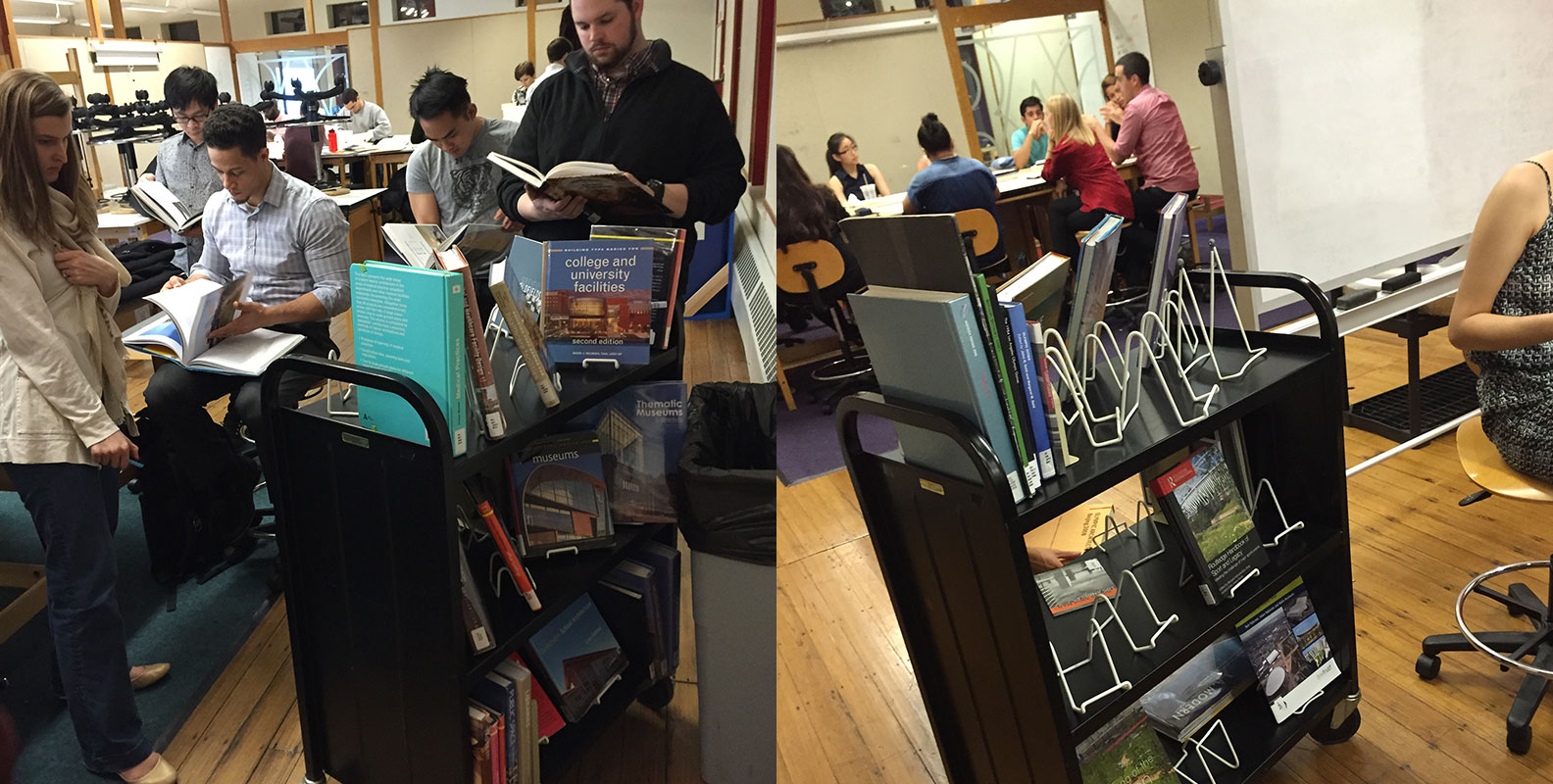
A trusty old library cart was liberated and a plan hatched to make book displays mobile. We targeted studios for which we knew we had great resources, over studios where the focus was more on using the woodshop or the materials lab. Each faculty member was emailed a tailored online guide and photos of the proposed mobile library cart stocked with helpful and appealing books. After a ten minute visit that allowed students to check books out right from the cart, we wheeled out of studio, leaving their hands filled with great books to kick off their research.  On average, half the books on the cart were checked out by the students and faculty.


Engaged students and a picked over cart.

With this very successful first effort we achieved our goal of reaching students who were not regular library users. Students actually told us how helpful this was–especially international students who felt uncomfortable searching the library catalog in English. In addition, informal polling of participating instructors revealed our Mobile Library visits improved the quality of student work.

One of the surprising outcomes was impact on our Reserve Collection. Prior to the Mobile Library, studio faculty would visit the library and pull books they knew on the topics they were teaching. This often resulted in dozens of books going on reserve in the hope that students would reference them. It was our experience that few would. The few students who did were faced with the sad fact that the book was on reserve and could not be taken home.

Mobile Library visits introduced faculty to additional resources on their topics, which, combined with the fact students were actively checking out books, caused faculty to rethink their reserve strategies. Instead of placing books on reserve, they are now borrowed, passed around, and better absorbed by more students. This has also cut down on the work load for the Reserves Department, and freed up two whole shelves of Reserve space.

Word has spread about the success of our Mobile Library visits. We have given presentations to the Education and Administration staffs at the college. This has prompted our Interior Architecture and Landscape programs to inquire about visits as well. The fall semester will find us rolling into both studios and classrooms.  Now if only we had a better book cart…


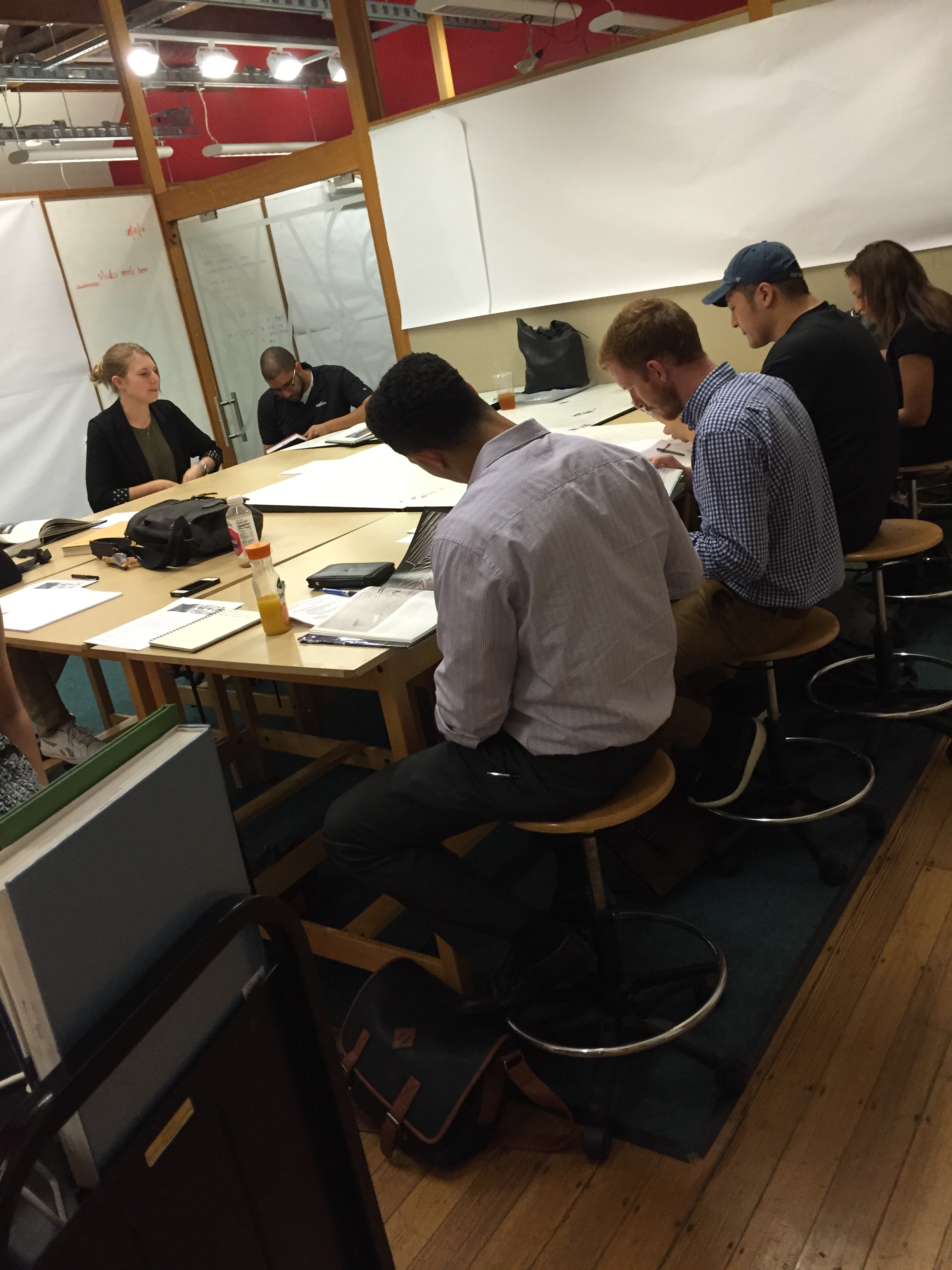
Students working in class with their newly acquired books.

Tips

  • We found it best to not over-pack the cart. We provide a sampling, not the whole collection. The students are less overwhelmed. They are then more motivated to visit the library to see what else we might offer.
  • Having an engaged faculty member makes the difference on how many books get checked out. One who points out why certain books are helpful to a student gets them to check books out.
  • We work in teams of two, so that one person can engage the users and answer questions.