
University of Southern California

Victor Regnier FAIA has been invited to reflect on the meaning and purpose of his research in the upcoming book “Environments in an Aging Society: Autobiographical Perspectives in Environmental Gerontology. The book includes the work of 17 researchers from seven countries who’s life work has created the basis for the discipline

Prof. G. Goetz Schierle has been invited as keynote speaker at the IEREK Conference in Cairo 2017 Cities through Architecture and Arts.

Patrick Tighe, FAIA, (Adjunct Professor) was awarded a 2015 AIACC Honor Award form the American Institute of Architects, California Council.

The proposal of Adjunct Associate Professor Michael Hricak, FAIA,  “Leadership and Creativity: What it takes to Lead Talented Individuals” has been accepted by the National AIA and he will be presenting at the 2007 AIA Convention in Orlando, FL. The material for this course was originally developed  for the summer professional EXED program at USC.

Hadrian Predock juried the LAGI – Land Art Generator Initiative in May, will be conducting a workshop and lecturing at UNLV school of architecture on October 8-10, and will be lecturing at Cal Poly Pomona on October 21st. He is beginning work on a multi-generational housing project in Muncie, Indiana. The catalog for Errors, Estrangement, Messes and Fictions – an exhibition curated by Hadrian for the USC School of Architecture – is now being widely disseminated. 

Maria Esnaola and her studio KnitKnot architecture started the construction of a school project for Nicaragua in El Jicarito. EL JICARITO SCHOOL is an innovative low-cost school design that brings a community together through collaborative construction.  On November 5th, Knit Knot will be one of the guest speakers at the TEDX at University of Macedonia 2016. Under the title “Gravity of Thoughts”, we will also organize a Workshop and installation that evaluates collaborative design techniques and construction.

Dr. Joon-Ho Choi received the USC Zumberge Research Innovation Fund based on one of his research topics, titled “Bio-Sensing Data-Driven Thermal Comfort Model.” His Human-Building Integration Research was invited to the International Energy Agency – Energy in Buildings and Communities Programs Annex 66 Expert Meeting, held in Carleton University, Ottawa, Canada. He presented “Impacts of Occupants on Building Performance: Extracting Information from Building Data” at the meeting. Dr. Choi has been invited to the 9th International Conference on Indoor Air Quality Ventilation & Energy Conservation” as a scientific committee, and he will make a presentation about two of his recent researches: Comprehensive Post-Occupancy Evaluation, and User-behavioral impacts on Building Energy Performance. He is also invited as an indoor environmental quality expert panel to the Workshop on the Value of Designing for the Occupant, held at the Catholic University of America in D.C., where user-centered environmental control and environmental/physiological benefits of sustainable design will be discussed.

Rob Berry with his firm Berry and Linné recently completed work on Todos Juntos, a new public space in the Boyle Heights neighborhood of Los Angeles. The project was the subject of a feature article in the April 26, 2016, West Edition of The Architect’s Newspaper. In May, Rob and his project collaborator Siobhán Burke of Lyric Design & Planning led a public tour of the project focused on the role of community outreach and creative culture in the design process. The tour was hosted by the design advocacy group Design East of La Brea (de LaB) as part of their Making LA series.

Jason Kerwin’s office, OKB Architecture, recently completed project for Newmark Grubb Knight Frank in downtown Los Angeles won a national award from Shaw Contract – Design Is Competition – and was featured in the latest NeoCon in Chicago. 

In April 2016 Sarah Cowles co-organized the international symposium” “THIS IS A TEST” at Knowlton School at The Ohio State University, on the role of testing and prototyping in landscape architecture. Her chapter “Bigger MPs (management practices) on the role of representation and landscape identity in watershed planning was recently published in Representing Landscapes: Hybrid by Nadia Amoroso (Routledge). In the fall of 2016 she will lead the seminar “Sylviculture: The Forest Garden in the 21st Century” at the Harvard Forest in Petersham, Massachusetts, and is returning Sweden in October to continue research on the Swedish Landscape Laboratory in Alnarp, Sweden with Roland Gustavsson.

Alvin Huang, AIA was invited to teach a visiting design workshop and give a lecture on his work as part of the inaugural Mosaic of Episodes event hosted by the Indian Institute of Architects in Bangalore, India from September 14-17, 2016. On October 29, Huang will be a keynote speaker at the Now Next Future Conference hosted by the AIA California Council in Los Angeles, CA. On October 30, Huang will present his paper entitled “From Bones to Bricks: Designing the 3D Printed Durotaxis Chair and La Burbuja Lamp” at the 2016 ACADIA Conference at the University of Michigan.

 

University of Nebraska-Lincoln

Project will use drones to survey wetland habitats

Nebraska researchers are turning to the air to help monitor wetland habitat conditions.

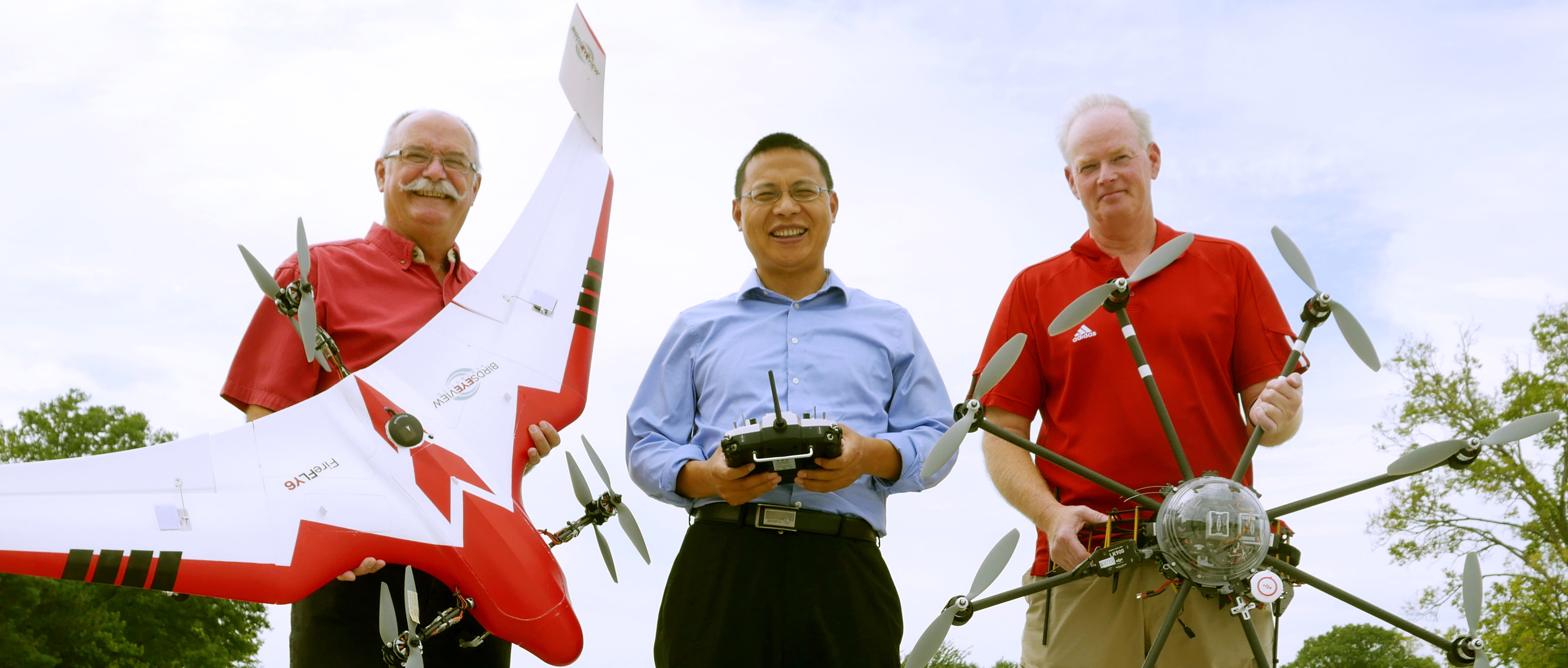
Funded through a $203,220 Environmental Protection Agency award, the University of Nebraska–Lincoln’s Zhenghong Tang and Wayne Woldt plan to develop a methodology to use unmanned aircraft systems to conduct dynamic monitoring and precise assessments of playa wetland habitats. Areas the team plans to focus on include hydrological conditions, vegetation and energy levels, and wildlife usage in the Nebraska Rainwater Basin.

Surveying the public waterfowl production and wildlife management areas across the basin will require multiple field trips to complete the data collection during the spring and fall migratory seasons.

During the drone flights, the team will use multispectral sensors for detection of soil moisture levels and mapping of wetland inundation during spring migration season; thermal imaging cameras and oblique photogrammetry for evaluation of wildlife use and its distribution on playa wetlands; and 3D imagery for surveys of plant community conditions, estimations of energy availability and assessments of vegetation management effectiveness.

The use of UAS is a huge improvement over the traditional large, plane or ground surveying methods commonly used. This method will provide improved imaging with greater resolution and detail in a cost-efficient, timely and flexible manner. The new surveying tools and applicable protocols will offer wetland managers a greater understanding of wetland spring inundation conditions. If this method proves effective, the methodology can be replicated elsewhere. Having this information for wildlife managers will advance conservation efforts.

“Conducting timely monitoring and accurate assessment is extremely important for wetland managers to implement appropriate conservation programs to increase the quantity and quality of wetlands,” said Jeff Drahota, U.S. Fish and Wildlife Service biologist with the Rainwater Basin Wetland Management District. “This Unmanned Aircraft System provides an advanced new tool to conduct more rapid, precise monitoring and assessment for playa wetlands.”

In the past, environmental disruptions such as reduction in water flow because of upstream diversions, sediment, invasive species and poor water quality have contributed to major losses in playa habitat. By keeping a closer eye on the situation, wildlife managers will be able to identify threats before they negatively influence the wetlands or reach a point that will be very costly and time intensive to restore. With successful adoption of the proposed methodologies, this project has the potential to transform reactive wildlife management to a proactive and efficient system.

The data analyzed during the assessment stage will help close the information gap and help wildlife managers implement proven restoration practices, choose more effective treatments and create a better understanding of this delicate ecosystem throughout its annual cycle.

“It is important to test and verify the innovative UAS methodology in wetland monitoring and assessment,” Tang said. “This project is a great first step to an exciting new way to conserve our wetlands.”

Tang is an associate professor of community and regional planning in the College of Architecture. Woldt is an associate professor of biological systems engineering. Tang and Woldt are co-principal investigators on the research project.

University of Nebraska-Lincoln


University of Nebraska’s College of Architecture Among Awardees at AIA-NE Annual Gala


At this year’s Excellence in Design Gala, the American Institute of Architects, Nebraska Chapter (AIA-NE) presented five Honor Awards and eleven Merit Awards selected from Nebraska architects’ submissions and evaluated by Ohio jurors.
Faculty, students and alumni from the College of Architecture were among the honorees. 

Architectural Program Director Jeffrey L. Day (and his Omaha and San Francisco based architectural firm Min | Day) won two distinguished honors at the event. Min | Day was presented with the following awards on September 29th:


  • • Honor Award in the Architecture category for their project entitled “Blue Barn Theatre & Box Car 10” Omaha, Nebraska.  This project was conceived as a new arts hub in a rapidly changing district near downtown Omaha. The experimental theatre opens to the city outdoors through a public open space anchored with a mixed-use building.
  • • Merit Award in the Unbuilt Architecture category for their project entitled “Hexad” Lincoln, NE. 

Hexad is a caretaker’s house for a private estate in a sculpture garden. The 832 sq. ft. building separates the basic functions of home into living, eating, bathing and sleeping, into four 160 sq. ft. wings. Current M.Arch student Jacob Doyle also worked on the Hexad project while an intern at Min | Day in 2016.


College of Architecture recent graduates were recognized as well. David Alcala and Joshua Puppe, both currently employed in BVH’s Lincoln office, won a Merit Award in the Emerging Professionals category for their project entitled “Ephemerality – St. Joseph’s Catholic Church,” a project they designed in ARCH 410 under studio instructor Mark Bacon’s direction.

In this design, the church is strengthened through the employment of light, material logic and the concept of ascension through architecture. The project’s goals were achieved through designing spaces around light such as the main chapel and other areas in darkness such as the private chapel to reflect the program of the room. The project was previously recognized with an SGH / Dri-Design scholarship.


Several College of Architecture alumni had their work recognized with the AIA-NE Excellence in Design awards and the full award list may be accessed through www.aiane.org website. The Excellence in Design program is an annual event for Nebraska architects who submit built and unbuilt projects for consideration. Categories for consideration include Architecture, Interior Architecture, Unbuilt, Excellence in Masonry and Details. For Emerging Architects the categories are Unbuilt Design and Architectural Detail.


Projects were judged based on a variety of features, including unique design, originality, extended use attributes, sustainability, budget and use of environmental surroundings. More information about each of these projects can be found at


http://www.aiane.org/aia_design_awards/2016_excellence_in_design_awards/.


University of Illinois, Urbana-Champaign

Professor David M. Chasco, FAIA was invited to lead a team of 4 Illinois School of Architecture graduate students – Meagan Radloff, Aarefa Kuresh Palgharwala, Kiel Fahnstrom and William Smarzewski – in the second Volterra, Italy 2016 International Design Workshop, sponsored by the University of Detroit-Mercy (UDM) School of Architecture and hosted by the Volterra- Detroit Foundation at the Volterra International Residential College. The Workshop was held from July 27 through August 6th, 2016.  Participating university teams included the University of Detroit-Mercy led by Professor Wladek Fuches (President, Volterra-Detroit Foundation), Warsaw Technological University (Poland) led by Dean/Professor Jan Slyke, Ph.D. and Professor Gorgio Castellano of the University of Pisa.

 Professor Chasco was invited to lead the 2016 Workshop and select an internationally accomplished Illinois School of Architecture alumnus as the Workshop Captain. Alumnus David Miller FAIA of the Miller Hull Partnership in Seattle was selected. David Miller provided overall design guidance as well as presenting two lectures: one on his lifetime of built design efforts including the expansion of the Pike Street Market in Seattle, and second lecture on his design philosophy and interpretation of the Gates of Volterra design approaches. Professor Fuchs presented the 3rd lecture on his findings of the design of the Volterra Roman Theatre.  Professor Chasco presented the 4th lecture on a retrospective design career in both practice and the academy.   The Workshop project titled “The Gates of Volterra” explored the contemporary re-interpretation of the role of the city gate in the historical urban context.

  Four university integrated teams of students designed urban and architectural responses respecting and integrating new contemporary uses at each gate: Porta all’Arco, Porta Fiorentina, Porta Selci, and Porta San Francesco. The students’ design efforts were exhibited and presented to various Volterra townspeople and stakeholders.  Professor Chasco has been invited by the University of Detroit-Mercy to participate in the Volterra 2017 Summer International Design Workshop as well as lead a graduate semester study abroad at the Volterra Center in the Fall of 2017.


Associate Professor Paul Kapp was recently appointed to the University of Notre Dame School of Architecture Graduate Program in Historic Preservation Board of Advisors.  

Associate Professor and Associate Director for the Collaborative for Cultural Heritage Management and Policy Paul Kapp’s essay, “Intangible Industrial Heritage,” was chosen as one of only eight essays for the US/ICOMOS Report, With a World of Heritage So Rich, a report commemorating the 50th anniversary of the National Historic Preservation Act. You can read his essay and the others on this website: http://www.usicomos.org/about/wwhsr/


Associate Professor Thérèse F. Tierney has been invited to present a Distinguished Faculty lecture by the Unit for Criticism & Interpretive Theory at UIUC. The lecture is titled, “Networked Urbanism: Geographies of Information” October 24th, 2016. 


ACSA Schools Join White House Educators Commitment on Resilient Design

Michael J. Monti, Executive Director

ACSA, together with the American Institute of Architects, invited our member programs to join the White House Educators Commitment on Resilient Design. The commitment follows from a May 2016 conference on Resilient Building Codes, where leaders from the design and construction industries endorsed an Industry Statement on Resilience. The statement defines resilience as “the ability to prepare and plan for, absorb, recover from, and more successfully adapt to adverse events.” The U.S. federal government sees these issues as national security issues, and AIA and ACSA continue to work with staff in the White House to develop this agenda. 
Following is a list of schools endorsing the Commitment, with the text of the commitment below:

American University of Sharjah, College of Architecture & Design, Sharjah, United Arab Emirates,

Boston Architectural College, School of Architecture, Boston, MA

Carnegie Mellon University, School of Architecture, Pittsburgh, PA

Florida Agricultural and Mechanical University, School of Architecture, Tallahassee, FL

Florida International University, Department of Architecture, Miami, FL

Howard University, College of Engineering and Architecture, Department of Architecture, Washington, DC

Kennesaw State University, Department of Architecture, Marietta, GA

Massachusetts College of Art and Design, Department of Architecture, Boston, MA

NewSchool of Architecture and Design, , San Diego, CA

Pennsylvania State University, Department of Architecture, University Park, PA

Rensselaer Polytechnic Institute, School of Architecture, Troy, NY

Rice University, School of Architecture, Houston, TX

Texas A&M University, College of Architecture, College Station, TX

Tufts University, Department of Urban and Environmental Policy and Planning, Medford, MA

Tulane University, School of Architecture, New Orleans, LA

University of Florida, College of Design, Construction and Planning, Gainesville, FL

University of Hawaii At Manoa, School of Architecture, Honolulu, HI

University of Idaho, Department of Architecture & Interior Design, Moscow, ID

University of Maryland, School of Architecture, Planning & Preservation, College Park, MD

University of New Mexico, School of Architecture & Planning, Albuquerque, NM

University of Oregon, Department of Architecture, Eugene, OR

University of Southern California, School of Architecture, Los Angeles, CA

University of the District of Columbia, College of Agriculture, Urban Sustainability & Environmental Sciences, Washington, DC

Virginia Tech, School of Architecture + Design, Blacksburg, VA

Washington University in St. Louis, Sam Fox School of Design & Visual Arts / Architecture Programs, St. Louis, MO

Woodbury University, School of Architecture, Burbank, CA

Educators Commitment on Resilient Design

We envision a future where our homes, schools, workplaces, and communities are resilient to extreme weather events and can adapt to the impacts of climate change. Making this future a reality will require a focus on resilient design across disciplines. Students who will lead the planning, design, engineering, development, construction, and retrofit of homes, buildings, and infrastructure must be prepared to build for resilience, both now and into the foreseeable future.  We commit to:

  • Inspiring and training the next generation of architecture, engineering, urban planning, and construction professionals to innovate and effectively address resilience to extreme weather events and climate change;
  • Connecting students and professionals with best-available science on the growing risks posed by extreme weather events and climate change;
  • Fostering interdisciplinary settings for students to develop the employable skills and professional networks needed to support resilient design; and
  • Pursuing life-long learning opportunities to continually advance our understanding of how to design and build for a resilient future.

Going Global: Using an Institutional Repository to Give Local Documents a New Life

Barbara Opar and Lucy Campbell, column editors

Column by Leslie Mathews, Head, Art + Architecture Library, Virginia Tech

Assessing the Art + Architecture Library collections this summer, I came across some unique items from Virginia Tech’s Community Design Assistance Center (CDAC), a research and outreach center within the College of Architecture and Urban Studies. The Center, located in downtown Blacksburg, provides underserved communities in southwest Virginia with low-cost planning and design assistance while providing students with an opportunity to get paid to work on conceptual plans for real projects. The Center produces spiral bound print publications of conceptual designs created for their clients. Because of their ungainly spiral bindings and potentially low usage I initially considered these items candidates for remote storage. However, after looking into circulation statistics, I found many had significant circulation. Looking more closely at the reports, I found this was a unique collection, relevant to students and locals interested in design for green spaces and urban renewal. I wanted to showcase these unique, local, and highly visual items while simultaneously promoting the valuable work of the Center. I immediately thought of digitizing these items, or making the already digital versions available online, since the Center has been continuously producing reports since 1988.

I reached out to Director of CDAC Elizabeth Gilboy to ask if she had digital copies and if she would like them to be made available online. She was happy to respond yes to both questions and I have now begun the work of adding the documents to our digital institutional repository, VTechWorks, which is crawled by Google and public to the world. At VT Libraries, our dedicated staff works directly with clients to facilitate the loading of data into VTechWorks. This process allowed me to hand off the CDAC account to our Repository Collections Specialist, Melissa Lohrey, who is working with CDAC to extract the necessary data, load it into VTechWorks, and add the appropriate metadata. This allows VT librarians to promote the service as a streamlined process that is advantageous to scholars and others affiliated with VT who want their information not only to be available, but also highly searchable and findable. The documents will also be discoverable as PDFs, Word Documents and a variety of other formats through our iteration of Shared Shelf within the Artstor database.

Now the reports are publicly available online, CDAC can further outreach efforts to potential clients and grant making authorities while inspiring others to do similar work or perhaps provide the impetus other groups need to make a case for urban renewal. Based on statistics tracking views and downloads at the city level, I have been surprised by the level of international interest. Several reports have been viewed in Canada, France, Germany, Australia, and Iran as well as cities from across the United States.

To see the CDAC page on VTechWorks, go to http://vtechworks.lib.vt.edu/handle/10919/71429. Note that usage statistics are publicly viewable from the last link on the lower right hand column.

Call for Nominations: 2017 ACSA Board of Directors

2017 Board of Directors
Deadline: October 19, 2016

The ACSA Nominations Committee invites nominations for two national officers and two regional directors on the 2017 Board of Directors. The open offices are Second Vice President and Secretary/Treasurer. The two open regional directorships are Mid-Atlantic Region Director and Northeast Region Director. Eligible nominees for all Board positions shall be full-time and/or tenured or tenure-track faculty members of full member schools. Nominees for the position of Regional Director must be on the faculty of a full member school in the represented region.


NATIONAL OFFICERS:
Second Vice President

The Second Vice President serves a four-year term beginning July 1, 2017. The elected person serves for one year respectively as Second Vice President, First Vice President/President-Elect, President, and Past President. As President, the elected individual presides at meetings of the Association and is responsible for calling meetings of the Board of Directors, preparing an agenda and presiding at such meetings. The President coordinates activities of the board, Association committees, and liaison representatives. The President serves as ACSA liaison with the officers of the American Institute of Architects, the National Council of Architectural Registration Boards, the National Architectural Accrediting Board, and the American Institute of Architecture Students; and serves as ACSA representative to the Five Presidents’ Council. During the term of office, the President also prepares a brief report of activities of the Association and the Board of Directors for dissemination to the constituent associations.

Secretary/Treasurer
The Secretary/Treasurer serves for a three-year term beginning July 1, 2017, keeps minutes of all Board of Directors meetings, and distributes copies of the minutes to all members of the Board. The Secretary/Treasurer maintains the Bylaws and Rules of the Board of the Association as well as all other documents required by corporate law, incorporating revisions and additions as required by action of the Association and Board of Directors. The Secretary/Treasurer oversees the financial accounts and the records of the Association and serves as Parliamentarian for the Association in connection with its Annual Meeting. 

The 2017 Nominations Committee is chaired by Marilys Nepomechie. Additional members include Carlos Reimers, Corey Griffin & Stephen Luoni, University of Arkansas. The Committee will review nominations for the national officers and develop a slate of two candidates for each position.


REGIONAL DIRECTORS:

Mid-Atlantic Region Director & Northeast Region Director

The term of office for a Regional Director is three years beginning July 1, 2017. Regional Directors serve the ACSA in at least three ways: As members of the Board of Directors, on a variety of national committees, and as executive officers of their regional constituent associations. In this latter role, the Regional Director sets the agenda and chairs meetings of his or her regional council. He or she maintains a file of regional records, correspondence, and minutes of regional meetings. He or she provides assistance to regional schools and organizations applying for institutional membership. The Director prepares annual reports of regional activities for publication in the Association’s annual report and provides updates to the constituency on both regional and national matters of note. He or she administers the nomination and election of the subsequent Regional Director and performs such other duties as may be assigned by the Board. Regional Directors are required to attend three Board meetings a year: a fall meeting which typically occurs in conjunction with the Administrator’s Conference, a spring meeting which typically occurs in conjunction with the ACSA Annual Meeting, and a summer meeting. 

Each region will have a Regional Nominations Committee made up of regional constituents that will review applications received, and develop a slate of not less than two nor more than three candidates.


Board Election ballots will be sent to all full member schools and appropriate regions by mid-January, 2017. The results of this election will be announced online and at the ACSA Annual Meeting in Detroit, MI in 2017. Candidates will be notified of the results in mid-February. 

Nominations for all ACSA Board positions should include a CV, a letter of interest from the nominee indicating a willingness to serve, and a candidate statement. The deadline for receipt of nominations is October 19, 2016.

Nominations should be sent to:

     Email (preferred): eellis@acsa-arch.org
Eric Ellis, ACSA Director of Operations and Programs
ACSA, Board Nominations
1735 New York Avenue, NW
Washington, DC 20006 


University of Nebraska-Lincoln

Olshavsky Writes Forward for Pérez-Gómez

How do you react when someone like Alberto Pérez-Gómez, one of the world’s leading architects and thinkers asks you to write a forward for a collection of essay’s he’s written over the last 30 years. 

Without question, you say yes! “It’s an honor to be able to write a forward for someone who has contributed so much to the field through their work and as an educator,” commented Dr. Peter Olshavsky. “I was even more excited by the idea that it was for a two-volume set that gathers together three decades of scholarship that has been personally meaningful to my work and my approach to architectural education at UNL.” 

The publisher describes the collection as a piece that deliberately blurs the edges of history and theory; the first volume focuses on architectural theories and practices both historical and recent, and the second on more general aspects of architectural philosophy.

Olshavsky entitled his forward, “The Untimely Thinking of Alberto Pérez-Gómez,” for the collection, Timely Meditations: Selected Essays on Architecture (2016).  Olshavsky’s forward argues for the “untimely” nature of Pérez-Gómez’s thinking while introducing this eminent historian’s remarkable collection of essays, which revises and builds upon his work.

Pérez-Gómez and Olshavsky have known each other for a long time. In fact Pérez-Gómez was Olshavsky’s doctoral supervisor at McGill University, and they continued to stay in contact.  Recently, Pérez-Gómez read one of Olshavsky’s essays in the 2015 book Architecture’s Appeal where Olshavsky described Pérez-Gómez’s work, so he reached out to Olshavsky and asked him to submit a text for his new essay collection. For more information visit:
https://www.createspace.com/6241830


Auburn University - July

July 2016

Three Auburn alumni were among the 149 elevated to the American Institute of Architects prestigious 2016 College of Fellows: Larry S. Cash (Chapter: AIA Alaska, Firm: RIM Architects); Paula Burns McEvoy (Chapter: AIA Atlanta, Firm: Perkins+Will); and C. Al York (Chapter: AIA Austin, Firm: McKinney York Architects). “We are extremely proud of Paula, Larry, and Al,” says David Hinson, Head of the School of Architecture, Planning and Landscape Architecture. “Elevation to the AIA College of Fellows is a fitting recognition of their positive impact on the profession and the benefits of their work to society. Their careers are a credit to Auburn, and our students and faculty are inspired by their example.”  For more, read here.

Josiah Brown, a fifth-year architecture student from Ashland City, Tennessee, is the School of Architecture, Planning and Landscape Architecture’s first recipient of the Aydelott Travel Award. The Aydelott Travel Award was established by Alfred Lewis Aydelott, FAIA (1916–2008) and his wife, Hope Galloway Aydelott (1920-2010), to encourage architecture students to “become proficient in the art of architectural analysis.” The $2.4 million endowment established by this well-known Memphis architect and his wife creates a $20,000 travel award for architecture students at four universities: Auburn University, Mississippi State University, the University of Arkansas-Fayetteville, and the University of Tennessee.  Read more here

The School of Architecture, Planning and Landscape Architecture was well represented among the award winners at the “This is Research: Student Symposium 2016,” held on April 13 at the Student Center. Out of the more than 400 undergraduate and graduate students who competed from Auburn and AUM, APLA students, Abigail Katsoulis and Madeline Gonzales, fifth-year architecture students, took home two first place awards and one second place in the Research and Creative Scholarship in Design, Arts and Humanities category. Ryan Bowen, a dual Environmental Design/Master of Landscape Architecture student, won first place for his poster presentation in the undergraduate category, and Livia Lima, a first–year MLA student, won second place in the graduate Creative Scholarship category for her oral presentation. To read more about the research, read here.

The Design Museum Foundation has developed a major, nationally-traveling exhibition on the importance of play and how designers translate play objectives into innovative, extraordinary, outdoor play environments. The exhibit, called “Extraordinary Playscapes,” includes Rural Studio’s Lions Park Playscape as one of the selected contributors. Currently open in Boston, the exhibit will be in Portland, OR next.  Read more here.

StudioAPLA:  the Summer Issue, the newsletter for the School of Architecture, Planning and Landscape Architecture’s, is available now.

Auburn University

August – September 2016

Three CADC students are among the 105 Auburn student-athletes named to the 2016 Spring SEC Academic Honor Roll. Lucas Grady, a senior in architecture, is a Men’s Track & Field athlete (Hurdles/Mid-distance); Veronica Elder is a junior in industrial design and a Women’s Track & Field athlete (Distance/Cross Country); and Marshay Ryan is a junior in architecture and Women’s Track and Field athlete (jumps). The 2016 Spring SEC Academic Honor Roll is based on grades from the 2015 Summer, 2015 Fall, and 2016 Spring terms. For more, click here.

Two CADC student-athletes are also on the First-Year SEC Academic Honor Roll list. Among the 84 Auburn student-athletes are Andrew Autrey (pre-Building Science) and Raymond Lester (Architecture). Each student-athlete must 1) have a cumulative GPA of 3.00 or above at the nominating institution; 2) be on scholarship or a letter winner; 3) have completed 24 semester hours of non-remedial credit at the nominating institution; and 4) have been a member of the varsity team for the sport’s entire NCAA Championship segment. For more, click here. 

Any student-athlete who participates in a Southeastern Conference championship sport or a student-athlete who participates in a sport listed on his/her institution’s NCAA Sports Sponsorship Form is eligible for nomination to the Academic Honor Roll.

Rachel Hamrick, a senior in the Environmental Design program from Eufaula, Alabama, was one of four recipients of the Outstanding ePortfolio Award for 2016. Hamrick received the honor during the third annual ePortfolio Awards Luncheon hosted by Provost Timothy Boosinger on May 3. She was nominated by Magdalena Garmaz, Environmental Design Program Chair and Ann & Batey Gresham Professor of Architecture.  For more, read here.

Professor Ben Farrow has been named the Associate Dean for Academic Affairs and International Programs for the College of Architecture, Design and Construction as of August 1. Farrow is a tenured Associate Professor and William Hunt Professor in the McWhorter School of Building Science and has been the chair of the undergraduate program in Building Science. He worked in industry for 15 years before he joined the Building Science faculty in 2006. In his new position, Farrow will be responsible for all matters broadly related to undergraduate academic programs in the college. He will work closely with college leadership and the faculty to assist with curricular processes, provide oversight of program assessment, oversee undergraduate study abroad programs and manage student recruitment, advising and placement. For more, read here.

Evan Forrest ‘09, Terran Wilson ‘09, Danny Wicke ‘07, & John Marusich ‘07 are Auburn Architecture alumni working in Chicago selected to participate in AIA Chicago’s Bridge mentorship program which pairs AIA Fellows with young aspiring architects looking to connect with the past while looking towards the future. The program and participants were featured in a full article in AIA Chicago’s Chicago Architect Magazine’s July/August issue titled “The Future of Architecture.” You can read the issue here.

Andrew Freear will be taking some well-deserved time off this year and has left Rural Studio in the capable hands of Xavier Vendrell as Acting Director and Fifth-year Professor. Vendrell has been Third-year visiting professor at Rural Studio for the past two years. He will focus the Studio on a combination of community, garden-to-table, and small home projects. A native of Barcelona, where he has been practicing architecture since 1983, Vendrell and his office won the competition for the Poblenou Park in the Olympic Village in Barcelona in 1988. Vendrell founded Xavier Vendrell Studio Chicago/Barcelona in 1999, a collaborative practice of architecture, landscape, and design.  For more RS fall teaching news, please click here.

Cakeitecture Bakery owner Carie Tindill, Auburn BArch ’05 and MIDC ‘06, and her assistant Kelly Oslick, competed on an August episode of Cake Wars.  For more, click here.